

For researchers and clinicians working on ultra-rare genetic diseases, the best adilabs.ai alternatives available in the United States are NexyRare Research, Clinakos Clarion, DeepRare, DeepSky, Orphera, Atinary SDLabs, and Hopeatrarelabs (RareLabs). Each platform addresses a distinct gap in the rare disease pipeline, from multi-omics diagnostics to autonomous experimentation and patient-specific treatment screening.
Here is a quick-reference breakdown of what each platform brings:
- NexyRare Research: Integrates four omics layers (genomics, transcriptomics, proteomics, metabolomics) with clinical phenotyping to shorten diagnostic odysseys.
- Clinakos Clarion: An AI research agent trained on 15+ years of patient data, purpose-built for rare diseases like Duchenne muscular dystrophy and Fabry disease.
- DeepRare: A modular agentic system integrating over 40 specialized tools with traceable diagnostic reasoning chains achieving 95.40% clinical expert agreement.
- DeepSky: Delivers personalized variant interpretation computed fresh for each patient, replacing static bioinformatics lookups with context-aware AI analysis.
- Orphera: Covers the full drug repurposing pipeline from discovery through regulatory pathway analysis, optimized for orphan drug economics.
- Atinary SDLabs: Combines AI with laboratory hardware for autonomous experimentation, compressing multi-year research timelines into weeks.
- Hopeatrarelabs (RareLabs): Builds patient-specific iPSC and CRISPR-based disease models, then runs parallel treatment screens across FDA-approved drugs, custom ASOs, and gene therapy options.
Table of Contents
- What are the best adilabs.ai alternatives for rare disease modeling?
- How does Hopeatrarelabs stand apart in personalized rare disease research?
- What innovations are reshaping AI-driven rare disease research?
- How do pricing models compare across these platforms in the United States?
- What customer support and institutional partnerships do these platforms offer?
- What does real-world use reveal about these platforms?
- How do these platforms handle regulatory compliance and data security?
- How long does onboarding take for each alternative?
- Hopeatrarelabs offers a different path to treatment discovery
- Key Takeaways
What are the best adilabs.ai alternatives for rare disease modeling?
The platforms above differ sharply in how they approach data, personalization, and clinical output. The table below maps each one across the dimensions that matter most to US-based researchers.
| Platform | Focus and technology approach | Data integration | Personalization methods | Research and treatment scope | Clinical applicability | Speed and transparency |
|---|---|---|---|---|---|---|
| NexyRare Research | Multi-omics intelligence and explainable AI | Genomics, transcriptomics, proteomics, metabolomics, HPO phenotyping | Variant and pathway ranking per patient | Diagnostic hypotheses, repurposing opportunities | Hospitals, diagnostic units, rare disease consortia | Auditable evidence per hypothesis |
| Clinakos Clarion | AI research agent for rare disease and oncology | 15+ years of integrated patient-level data | Disease-specific insight generation with confidence scores | Clinical and commercial decision support | Researchers, biopharma teams | Data-backed answers with confidence scoring |
| DeepRare | Agentic LLM system for rare disease diagnosis | Web-scale medical knowledge, 40+ specialized tools | Ranked hypotheses per heterogeneous clinical input | Diagnostic across 2,919 diseases | Clinicians, clinical research teams | Transparent reasoning chains; 95.40% expert agreement |
| DeepSky | Personalized genomic variant interpretation | Full patient genome context | Fresh AI computation per individual | Variant effect prediction, therapeutic response stratification | Precision medicine programs, pharma partners | Privacy-by-design; algorithms go to data, not vice versa |
| Orphera | End-to-end rare disease drug repurposing | Rare disease literature, omics, regulatory data | Drug-disease pair scoring with competitive intelligence | Discovery through regulatory pathway analysis | Biopharma, regulatory teams | Go/No-go cards; structured route analysis |
| Atinary SDLabs | Autonomous AI-driven experimentation | LIMS, lab robotics, ELN integration | AI-optimized multi-parameter experiment design | Formulation, synthesis, catalysis, small molecule R&D | Research labs, life sciences teams | Onboard in under two hours; SOC-2 compliant on AWS |
| Hopeatrarelabs (RareLabs) | Patient-specific iPSC and CRISPR disease modeling | Patient cell-derived models, FDA drug libraries, ASO design | Personalized models from each patient's own cells | FDA-approved drugs, custom ASOs, gene therapy screening | Patients, physicians, foundations, biopharma | Rapid, transparent, scientifically rigorous workflow |
DeepRare's microservices architecture with Redis session management and SQL databases ensures strong data security suitable for clinical deployment. Atinary SDLabs is SOC-2 compliant and hosted on AWS, with built-in encryption, access management, and audit trails supporting GDPR and CCPA requirements.
How does Hopeatrarelabs stand apart in personalized rare disease research?
Hopeatrarelabs operates at a level of biological specificity that software-only platforms cannot replicate. The core workflow starts with a patient's own cells, reprogrammed into induced pluripotent stem cells (iPSCs) using CRISPR gene editing, creating a living model of that individual's disease rather than a statistical approximation.

From that model, Hopeatrarelabs runs parallel treatment screens across thousands of FDA-approved drugs, custom antisense oligonucleotides (ASOs), and gene therapy candidates. No other platform on this list combines wet-lab disease modeling with that breadth of therapeutic screening in a single workflow.
Key attributes that define the Hopeatrarelabs approach:
- Patient-derived models: Every disease model comes from the patient's own biology, not a generic cell line or population average.
- Parallel treatment screening: Thousands of compounds tested simultaneously, including FDA-approved drugs, custom ASOs, and gene therapy options.
- Scientific traceability: Results are documented with the rigor required for physician review and biopharma partnership.
- Speed under urgency: The workflow is designed for patients who cannot wait years for a clinical trial to materialize.
- Transparent communication: Families, physicians, and foundations receive clear, actionable reports at each stage.
For clinicians managing a patient with a disease that has no approved treatment, the personalized research process Hopeatrarelabs runs is often the only path that accounts for that specific patient's genetic context.
What innovations are reshaping AI-driven rare disease research?
The field is moving fast, and several trends are redefining what researchers should expect from any platform they evaluate.
- Modular agentic AI: DeepRare's architecture, with over 40 specialized tools and web-scale medical knowledge, demonstrates that diagnostic accuracy scales with modularity. Static monolithic models are losing ground to systems that can pull from current clinical sources and reason across them.
- Context-aware variant interpretation: DeepSky's approach, computing a fresh genomic analysis for each patient rather than matching against a fixed database, reflects where the field is heading. Static lookups miss interactions that only appear in the context of a full genome.
- Autonomous experimentation: Atinary SDLabs integrates AI with robotics to run closed-loop experiments without manual intervention, compressing what used to take years into weeks. The key enabler is direct LIMS integration, which eliminates data transfer bottlenecks between the AI system and the physical lab.
- Traceable reasoning chains: Clinical adoption of AI diagnostics depends on explainability. DeepRare's 95.40% expert agreement rate is directly tied to its ability to show clinicians exactly how each hypothesis was reached.
- Privacy-first architectures: DeepSky's model, where algorithms travel to the data rather than the reverse, is becoming a standard expectation for US-based clinical partners. Researchers evaluating rare disease real-world evidence platforms should treat data custody as a non-negotiable evaluation criterion.
How do pricing models compare across these platforms in the United States?
Pricing across this category is not publicly standardized. Most platforms operate on custom enterprise contracts, reflecting the complexity of implementation and the specificity of rare disease research needs.
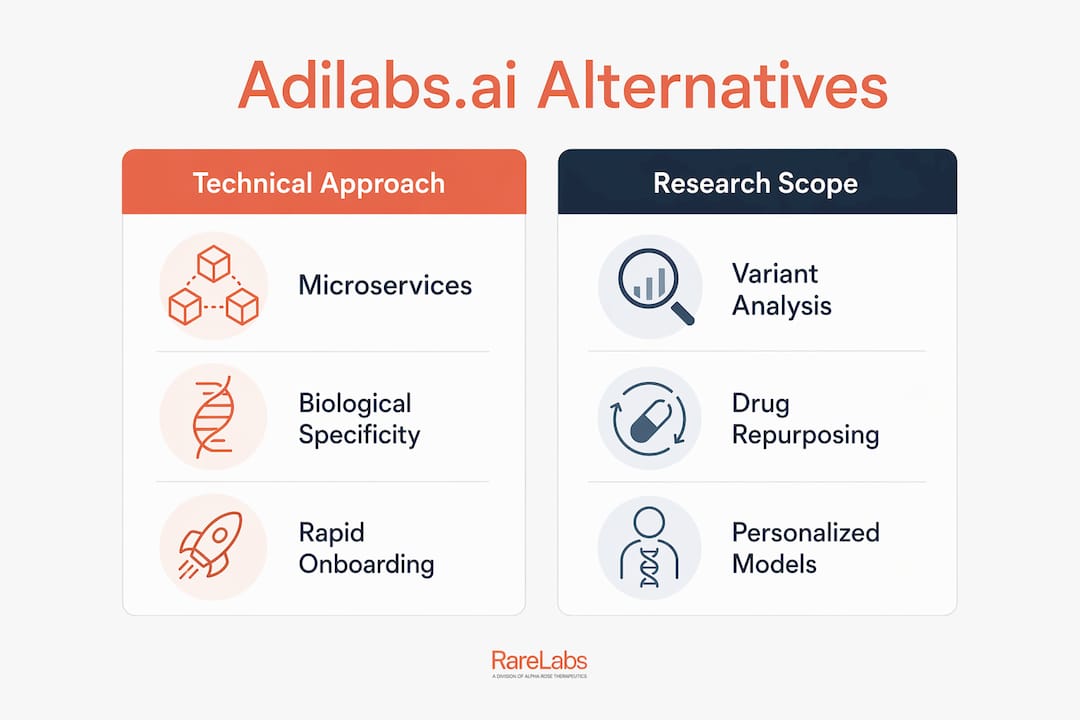
Atinary SDLabs is the clearest exception: the platform advertises onboarding in under two hours with no coding required, suggesting a more accessible entry point for research labs without large IT teams. Orphera's modular pipeline structure (Discovery, Intelligence, Regulatory, Evidence) implies tiered access, where teams can engage specific modules rather than purchasing the full stack. Clinakos Clarion, NexyRare Research, DeepSky, and DeepRare do not publish list pricing publicly; engagement typically begins with a scoping conversation.
Hopeatrarelabs (RareLabs) pricing is structured around the specific scope of each patient's disease modeling and treatment screening project. Given the wet-lab component and the depth of parallel screening involved, costs reflect a bespoke research engagement rather than a software subscription.
What customer support and institutional partnerships do these platforms offer?
Support quality varies considerably. Atinary SDLabs explicitly highlights its technical support team and AI roadmap responsiveness, with researchers noting the support is "clearly designed with the needs of researchers in mind." NexyRare Research targets hospitals, diagnostic units, rare disease consortia, and niche pharma, suggesting structured partnership frameworks rather than self-serve onboarding.
Clinakos Clarion is purpose-built for researchers and biopharma teams making clinical and commercial decisions, which typically means dedicated account support. DeepRare has been deployed as a web application for clinical use, with API access available for institutional integration. Hopeatrarelabs works directly with patients, families, physicians, foundations, and biopharma partners, with a workflow designed for close collaboration at every stage of the research process.
What does real-world use reveal about these platforms?
DeepRare's performance across eight evaluation datasets, covering 2,919 diseases, gives it the most documented clinical validation of any platform in this comparison. Its Recall@1 score of 57.18% in HPO-based evaluations outpaces the next-best method by 23.79 percentage points. For multi-modal inputs, it reaches 70.60% Recall@1 versus 53.20% for Exomiser across 109 cases.
Atinary SDLabs has published researcher feedback confirming it outperformed open-source and commercial alternatives in exploring large, complex design spaces with fewer experiments. DeepSky points to the case of KJ, a patient whose personalized genomic analysis informed a therapy that would not have been identified through standard methods, as a concrete illustration of what context-aware variant interpretation can achieve at the individual level.
Hopeatrarelabs operates in a space where published case studies are limited by patient privacy, but the platform's design, building a disease model from each patient's own cells and screening thousands of compounds in parallel, is grounded in the same iPSC and CRISPR methodologies that underpin peer-reviewed rare disease research.
How do these platforms handle regulatory compliance and data security?
For US-based researchers, HIPAA compliance and data custody are baseline requirements. Atinary SDLabs is SOC-2 certified and hosted on AWS, with encryption, access management, and audit trails that support both GDPR and CCPA. DeepRare's microservices design with local LLM deployment keeps sensitive patient data within controlled infrastructure rather than routing it through external APIs. DeepSky's privacy-by-design architecture ensures that partner institutions retain full custody of patient information throughout the analysis process.
Orphera's drug repurposing pipeline incorporates regulatory pathway analysis as a core module, meaning compliance considerations are built into the research workflow rather than added afterward. Platforms without published compliance certifications should be evaluated carefully before any identifiable patient data is processed.
How long does onboarding take for each alternative?
Atinary SDLabs offers rapid onboarding via browser, requiring no coding or machine learning expertise, enabling quick deployment for research labs. That speed is possible because the platform is designed for scientists, not engineers.
DeepRare offers a pre-deployed web application for immediate access, with API integration available for institutions that need deeper connectivity. Clinakos Clarion, NexyRare Research, DeepSky, and Orphera do not publish specific onboarding timelines, and implementation complexity likely scales with the depth of data integration required. Hopeatrarelabs engages each case individually, with timelines tied to the scope of disease modeling and treatment screening rather than a fixed software deployment schedule.
Hopeatrarelabs offers a different path to treatment discovery
The platforms compared here are powerful tools for diagnostics, variant analysis, and drug repurposing. Hopeatrarelabs does something none of them do: it builds a living model of a specific patient's disease from that patient's own cells, then screens thousands of real therapeutic candidates against it.
For US-based researchers and clinicians facing an ultra-rare disease with no approved treatment, that distinction matters in practice. Software platforms generate hypotheses. Hopeatrarelabs generates biological evidence. The personalized disease modeling and treatment screening workflow at Hopeatrarelabs is designed for exactly the cases where population-level AI analysis runs out of answers. Contact Hopeatrarelabs directly to discuss your patient's case and learn what a personalized treatment screen could reveal.
Key Takeaways
The most effective approach to finding adilabs.ai alternatives for ultra-rare genetic disease research is matching each platform's core technology to the specific gap in your research or clinical workflow.
| Point | Details |
|---|---|
| Multi-omics integration | NexyRare Research combines four omics layers with clinical phenotyping for explainable diagnostic hypotheses. |
| Traceable AI diagnostics | DeepRare achieves 95.40% clinical expert agreement using modular agentic design with transparent reasoning chains. |
| Personalized variant analysis | DeepSky computes a fresh genomic interpretation for each patient, replacing static database lookups. |
| Autonomous experimentation | Atinary SDLabs integrates AI with lab robotics and LIMS, onboarding in under two hours with SOC-2 compliance. |
| Hopeatrarelabs (RareLabs) | Builds patient-specific iPSC and CRISPR disease models and screens thousands of FDA-approved drugs, ASOs, and gene therapies in parallel. |