

Securing patient-specific disease modeling services that deliver both translational relevance and customizable assays often turns into a bottleneck for biotech teams and rare disease families. Many existing providers limit projects by offering only off-the-shelf cell lines, restricting rapid parallel testing, or requiring long timelines with unclear pricing structures. This side-by-side comparison covers turnarounds, patient matching, and customization options across leading agencies so you can prioritize the model that fits your clinical or research needs.
Table of Contents
- RareLabs
- Disease Modeling Services with Patient-Derived iPSCs
- Creative Biolabs Custom Disease Modeling Service
- Comparative Analysis
RareLabs
At a Glance
RareLabs' marketing materials state a credible treatment path can be created in approximately 12-15 months, a specific timeline that frames the lab's urgency and ambitions for ultra-rare cases. The lab operates as a division of AlphaRose Therapeutics and centers on patient-derived modeling.
Core Features
RareLabs builds patient-specific disease models from blood or skin samples using induced pluripotent stem cells (iPSCs) and generates CRISPR-corrected control lines for direct comparison. The team runs high-throughput screens of about 3,000 FDA-approved drugs, and designs custom antisense oligonucleotides and gene therapy candidates.
Key Differentiator
The lab runs treatment discovery in parallel rather than serially, which compresses experimental timelines by testing many candidates at once and prioritizing leads quickly. That parallel approach is the single operational choice that most affects how fast results move from bench to clinical conversation.
Pros
-
Rapid parallel testing speeds identification of plausible options. Running drug screens, ASO designs, and gene therapy evaluations at the same time reduces wait time between experiments and follow-up tests.
-
Personalized, patient-specific models ensure comparisons use a patient-matched control rather than unrelated cell lines. That reduces biological noise when interpreting response signals.
-
Transparent progress updates and tailored communication keep families, physicians, and foundations informed about assay milestones and next steps. Regular updates reduce the uncertainty families often face.
-
The lab collaborates with biopharma and physicians to translate promising hits into development paths. Partnering options create realistic routes for follow-through beyond initial screens.
Cons
- Limited to rare disease patient populations, so RareLabs is not a practical option for common conditions or broad population studies.
Who It's For
Families with patients facing rare genetic diseases who have no approved treatments will find RareLabs relevant. Physicians, foundations, and biopharma partners seeking an accelerated, patient-centric route to identify candidate therapies also fit this offering.
Unique Value Proposition
RareLabs pairs patient-derived iPSC models with CRISPR-corrected controls and parallel screening of drugs and genetic therapies. That combination turns early lab hits into defensible candidate lists clinicians can discuss with patients and sponsors without waiting for multiple sequential campaigns.
Real World Use Case
A clinician refers a patient with an undiagnosed genetic mutation. RareLabs reprograms the patient sample into iPSCs, runs parallel small-molecule and ASO screens against a CRISPR-corrected control, and delivers a ranked list of candidates for clinical evaluation within months, not years.
Pricing
Not applicable. The product data indicates the listing is informational only and does not provide public pricing tiers. Project scope and partnerships typically determine budgets and timelines for individual programs.
Website: https://hopeatrarelabs.com
Disease Modeling Services with Patient-Derived iPSCs
At a Glance
Patient-derived cardiac organoids and longitudinal iPSC-based 2D and 3D models for heart disease form the core offering, and the vendor states their methods were validated in clinical studies. That validation claim is central to how Telescope Therapeutics markets translational confidence.
Core Features
The offering bundles a set of lab and study capabilities built around human cells.
- Patient-derived iPSC-based 2D and 3D culture systems for modeling disease at the cellular and tissue levels.
- Multi-cell cardiac constructs that reproduce structural changes and hypertrophy seen in heart disease.
- Support for longitudinal monitoring so you can track disease progression and treatment effects over weeks to months.
- Creation of cardiac and expanding kidney organoids to mirror organ-specific pathology.
- Inclusion of multiple heart cell types to improve tissue-level fidelity.
Key Differentiator
Telescope Therapeutics positions patient-derived cardiac organoids as a first-mover in drug development pipelines, and that validation claim above is the vendor’s primary credibility signal. For teams seeking human-relevant cardiac tissue models rather than animal surrogates, this focus changes which preclinical questions can be addressed.
Pros
-
Provides human-relevant models that let you observe tissue-level responses rather than inferring from single-cell assays. That increases the biological context available to pharmacology teams.
-
Enables personalized medicine workflows by generating iPSCs from individual patients, useful when genetic background alters drug response.
-
The pipeline supports longitudinal readouts, so you can see structural changes and therapeutic impact over time rather than a single endpoint.
-
Methods are described as clinically validated, which gives translational teams a defensible reference when building IND enabling packages or academic collaborations.
-
Expansion into kidney organoids widens the set of disease programs you can prototype without requalifying a new vendor relationship.
Cons
-
High technical complexity. Organoid production requires specialized staff and QC that push cost per sample well above standard cell line assays.
-
Scalability issues for large compound libraries. The service is better suited to targeted panels than high throughput screens aimed at thousands of compounds.
-
Turnaround and reagent costs can be significant, so short timelines or constrained budgets will feel pressure.
When It May Not Fit
If your program requires true high throughput screening at library scale or automated plate-based IC50 campaigns, this offering will be a poor match. Also avoid it for quick feasibility work where inexpensive immortalized cell lines suffice. The model excels when human relevance outweighs per-sample cost.
Who It's For
Research institutions, translational units, and pharmaceutical discovery teams focused on cardiac disease who need patient-specific tissue context for mechanism studies or lead selection. It also fits groups preparing targeted preclinical evidence for small molecule or biologic programs.
Real World Use Case
A biotech research group used patient-derived cardiac organoids to compare drug responses across three genotyped patient cohorts and to observe hypertrophy reversal over a six week dosing schedule. The approach refined candidate selection before committing to costly animal studies.
Pricing
Pricing is not published. The vendor lists pricing as not applicable and informational only, which implies study-level, custom engagements rather than a fixed SaaS subscription or a per-sample price sheet.
Website: https://telescopetherapeutics.com/services/model
Creative Biolabs Custom Disease Modeling Service
At a Glance
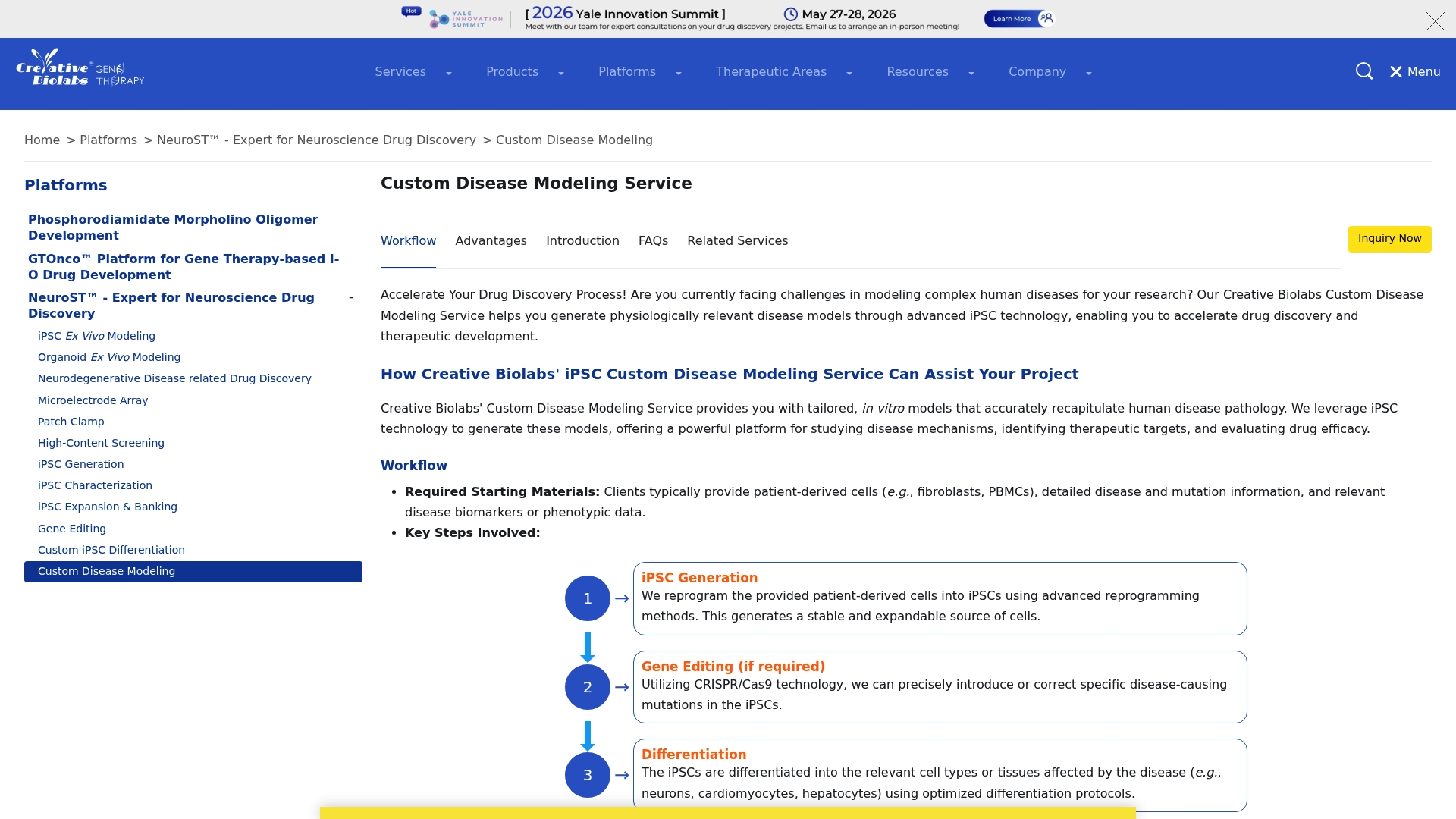
The vendor advertises typical project durations of 12 to 20 weeks for custom iPSC disease models, from reprogramming through validation. That timeline is a clear trade off: thorough model generation instead of the fastest possible turnaround.
Core Features
- Patient-derived reprogramming into iPSC lines for human cellular context.
- Precise gene editing using CRISPR/Cas9 applied in iPSCs to create disease or isogenic control lines.
- Directed differentiation into target cell types and tissues relevant to the disease under study.
- Rigorous quality control and validation assays to confirm identity and phenotype.
- Customized assay development for screening, efficacy testing, or mechanistic studies.
Key Differentiator
Creative Biolabs pairs patient-derived iPSC workflows with targeted gene editing to deliver ready-to-use human disease models and bespoke assays. Compared with Hopeatrarelabs' focus on rapid parallel treatment screening and translational testing, this offering concentrates on producing validated cellular models that other teams can use for downstream screens or mechanistic work.
Pros
- Produces human-relevant models that reflect patient biology, which helps when animal data translate poorly to people.
- Supports creation of isogenic control and disease pairs, reducing genetic background noise in experiments.
- Offers flexible customization so assays match the biology you need to measure rather than forcing a prebuilt readout.
- Laboratory validation steps increase confidence that a model actually expresses the expected phenotype.
- Suitable for pharmaceutical teams that need reproducible cellular reagents for target validation or preclinical testing.
Cons
- The timeline above makes this less suitable for projects that require immediate results within days or a few weeks.
- Modeling complex diseases that need multiple interacting cell types can be technically challenging and increase cost and time.
- Outcomes depend on the quality of patient material provided by clients, which adds variability outside the vendor's control.
When It May Not Fit
If you need rapid functional readouts or parallel small molecule screens within a two to four week window, this service is the wrong fit. If your program requires whole organism context or multi-organ interactions, a single iPSC-derived model will be insufficient. Also avoid this route when patient samples are scarce or of poor viability.
Who It's For
Research scientists, translational teams, and pharmaceutical developers focused on cellular mechanisms and target validation will get the most value. Teams that plan follow up high-throughput screening or bespoke assay development will find the model handoff useful.
Real World Use Case
A biotech startup commissioned a custom neuronal iPSC model with a disease mutation introduced by CRISPR/Cas9. The validated cells were used to test neuroprotective candidates, prioritizing two leads and reducing early-stage in vivo experiments and timeline uncertainty.
Pricing
Pricing is not published; the product data marks the offering as informational only. Creative Biolabs typically provides custom quotes per project based on scope, cell types, and assay development needs.
Website: https://creative-biolabs.com/gene-therapy/custom-disease-modeling.htm
Comparative Analysis
When evaluating services for patient-specific disease modeling, it's crucial to compare not only the technical methodologies employed by the providers but also the outcomes and respective support offered during the process. Below, we assess three such providers: RareLabs, Telescope Therapeutics, and Creative Biolabs.
Methodology Efficiency and Speed
RareLabs sets itself apart by employing parallel experimentation workflows, such as simultaneously evaluating drug screens, antisense oligonucleotides, and gene therapy candidates. This approach condenses discovery timelines, delivering results with reduced waiting periods. In contrast, Creative Biolabs adopts a more staged and thorough approach, necessitating longer project durations but allowing for rigorous validation of disease models. Telescope Therapeutics delivers a focused approach on longitudinal modeling, observing intricate cellular pharmacological responses over time, which, while detailed, naturally extends project timelines more than RareLabs’ concurrent tactics.
Scope and Application Breadth
While RareLabs is dedicated to rare genetic diseases and offers personalized patient-derived approaches, its focus limits applicability to broader or non-genetic conditions. Telescope Therapeutics specializes in cardiac and renal pathologies through advanced organoid modeling, making it a unique solution for teams needing organ-specific insights. Meanwhile, Creative Biolabs provides highly customizable models suitable for pharmaceutical research, accommodating varied experimental designs to address specific scientific questions.
Best Fit Recommendations
- RareLabs: Ideal for stakeholders seeking rapid identification of treatment options within ultra-rare genetic diseases, where speed and patient specificity are due to critical health risks.
- Telescope Therapeutics: Best for teams focusing on cardiac or renal diseases requiring longitudinal organoid studies, providing advanced modeling for structural and tissue-level observations.
- Creative Biolabs: Recommended for pharmaceutical developers needing bespoke and highly validated cellular models for downstream applications, suitable for programs requiring substantial customization.
Our Pick
For families and physicians navigating the challenges of ultra-rare genetic conditions, RareLabs delivers a compelling value through its accelerated, patient-centric discovery process utilizing a unique parallel testing model. Nevertheless, if your program targets non-genetic diseases, demands longitudinal insights, or requires highly tailored disease models, collaborating with Telescope Therapeutics or Creative Biolabs may represent the more aligned decision.
Patient-Specific Disease Modeling Services Comparison
When deciding on a provider for patient-specific disease modeling, consider their timeline acceleration features and the focus of their offerings.
| Product | Core Feature | Key Differentiator | Best For | Pricing | Notable Limitation |
|---|---|---|---|---|---|
| RareLabs | Patient-derived iPSCs, CRISPR control lines | Parallel treatment discovery accelerates timelines | Rare disease physicians, families, biopharma | Not disclosed | Only applicable for rare disease cases |
| Telescope Therapeutics | iPSCs, 2D/3D cardiac organoids | Clinically validated cardiac preclinical models | Cardiac disease research, translational teams | Not disclosed | High costs, not suitable for high-throughput library screens |
| Creative Biolabs | iPSC disease modeling with gene editing | Customized models with CRISPR for mechanistic studies | Mechanistic study-focused research scientists | Not disclosed | Extended timeline, quality of patient material impacts result |
Discover Patient-Centered Solutions Beyond hopehappenshealing.com Alternatives
Facing the challenge of finding effective treatments for ultra-rare or undiagnosed genetic diseases can feel overwhelming. When time and precision matter most, Hopeatrarelabs offers a rapid, transparent alternative designed just for patients and families seeking personalized answers. Their use of patient-derived iPSC models combined with CRISPR-corrected controls and parallel testing of thousands of FDA-approved drugs provides actionable insights faster than traditional sequential approaches.
Explore how Hopeatrarelabs accelerates treatment discovery through scientific rigor and patient-specific modeling at Hopeatrarelabs. Don’t let uncertainty delay hope. Contact their team to receive a ranked list of therapeutic candidates tailored to your patient’s unique genetic profile within months instead of years.
Frequently Asked Questions
How does RareLabs accelerate the treatment discovery process for rare diseases?
RareLabs accelerates discovery by running treatment experiments in parallel rather than serially. This approach reduces wait times and enables a quick prioritization of potential treatments, which is critical when addressing ultra-rare diseases. Families looking for expedited solutions will find this aspect particularly beneficial.
What is the difference between RareLabs and Telescope Therapeutics?
Telescope Therapeutics provides human-relevant cardiac organoids validated by clinical studies, making them a strong choice for modeling heart disease. RareLabs focuses primarily on personalized disease modeling for ultra-rare genetic conditions, which makes it the more suitable option for families facing uncommon genetic disorders without existing treatments.
Which platform offers personalized disease models that reduce biological noise?
RareLabs creates patient-specific disease models utilizing induced pluripotent stem cells (iPSCs) for accurate comparisons. This personalized approach minimizes biological variance when interpreting treatment responses, making it particularly effective for families exploring novel therapeutic options.
Can I use Telescope Therapeutics if I need high-throughput screening for drug candidates?
Telescope Therapeutics may not fit well for high-throughput screening, as their process is designed for human-relevant models rather than rapid compound testing. For high-throughput needs, RareLabs is a better fit due to their capability to run multiple treatments in parallel, reducing time for preliminary investigations.
How does Creative Biolabs ensure the quality of its iPSC disease models?
Creative Biolabs conducts rigorous quality control and validation assays to ensure the identity and phenotype of their iPSC models. This attention to detail provides researchers with confidence in the cellular models they employ for screening and mechanistic studies, helping to drive precise drug development efforts.