

The working AAV packaging limit is approximately 4.7 kb, including both inverted terminal repeats (ITRs), and that number gets treated as a hard ceiling more often than it should. Practical cassette design tops out closer to 4.4–4.5 kb once you account for promoter, coding sequence, and polyA. Genomic integrity and the fraction of full particles start dropping around 4.9–5.0 kb, and while a handful of studies report encapsidation up to 6 kb, those genomes usually come out truncated or poorly infectious.
TL;DR:
- Most AAV packaging experiments show a practical limit of around 4.4 to 4.5 kb for functional genome size, after accounting for ITRs, promoter, and regulatory elements.
- Studies claiming packaging at 5.5 to 6 kb usually measure DNA mass or partial genomes, not full-length, fully infectious particles, often leading to overestimates.
- Long-read nanopore sequencing reveals a sharp decline in full-length genomes at about 4.9 to 5.0 kb, with oversized genomes producing consistent truncation patterns.
- The 4.7 kb figure reflects capsid volume limits, constraining the total payload, including both ITRs, which consume about 290 bp each.
- Approaching the 5 kb limit significantly reduces full-genome proportion and infectivity, affecting manufacturing yield, regulatory compliance, and dosing consistency.
Table of Contents
- AAV Packaging Limit Discrepancies: Reconciling 4.7 kb, 5.2 kb, and Higher Reports
- Why Capsid Geometry and ITR Length Set a Physical Ceiling
- What Happens to Genome Integrity Past 4.9–5.0 kb
- Split-Vector and Mini-Gene Strategies for Oversized Transgenes
- Manufacturing Consequences: Yield, Purity, and Regulatory Benchmarks
- A Design Checklist for Cassettes Near the AAV Packaging Limit
- How Hopeatrarelabs Supports Feasibility Work on Large-Gene Constructs
- Selected Primary Sources and Further Reading
- Why the 4.7 kb Number Gets Treated as More Rigid Than It Is
- Sources
AAV Packaging Limit Discrepancies: Reconciling 4.7 kb, 5.2 kb, and Higher Reports
If you've read three papers on AAV capacity and gotten three different numbers, you're not misreading anything. The wild-type AAV genome runs about 4.7 kb, and classic packaging studies place the functional optimum somewhere in the 4.1–4.9 kb window. Genomes creeping past that range don't hit a wall so much as a slope: transduction efficiency starts declining well before packaging fails outright, and research on AAV serotype capacity shows that genomes larger than roughly 5.2 kb can still be encapsidated, just with meaningfully reduced infectivity.
The disagreement in the literature comes down almost entirely to what each assay is actually measuring.
- Dot blot and alkaline agarose gels detect total packaged DNA mass but can't distinguish a full-length genome from a truncated fragment of similar size, which inflates apparent capacity.
- qPCR quantifies genome copies against a standard curve, but primer placement matters enormously. Amplicons near one ITR will report "full" liters even when the opposite end of the genome is missing.
- Analytical ultracentrifugation (AUC) separates particles by sedimentation velocity, giving a genuinely useful full-versus-empty ratio, but it doesn't tell you whether the "full" particles carry the intended sequence intact.
- Long-read nanopore sequencing is the only method that maps the actual packaged sequence end to end, and it's the technique responsible for most of the recent downward revisions in reported capacity.
That last point matters. When a study reports encapsidation at 5.5 or 6 kb using dot blot or qPCR alone, it's usually reporting DNA mass, not verified full-length genome content. Once long-read sequencing enters the picture, those same oversized constructs frequently show extensive truncation, with the packaged fragments clustering toward one ITR rather than representing the complete cassette. The genome got packaged. It just wasn't the genome you designed.
This is why serotype and production context change the numbers people quote. A construct that looks like it packages efficiently at 5.0 kb in one lab's qPCR data might show a collapsed full-genome fraction in another lab's AUC or sequencing data. Both results can be technically accurate. They're just answering different questions. If you're benchmarking your own construct against published capacity figures, match your assay to the one used in the source study, or you'll end up comparing DNA mass to genome fidelity and drawing the wrong conclusion about where your real ceiling sits.
Why Capsid Geometry and ITR Length Set a Physical Ceiling
The 4.7 kb figure isn't arbitrary. It reflects the physical volume of the AAV capsid, a roughly 25 nanometer icosahedral shell built from 60 copies of VP1, VP2, and VP3 in an approximate 1:1:10 ratio. That shell has a fixed internal volume, and single-stranded DNA takes up space in a fairly predictable way. There's no soft engineering fix for the fact that a sphere of a given diameter can only hold so much single-stranded nucleic acid before packaging becomes energetically unfavorable or mechanically impossible.
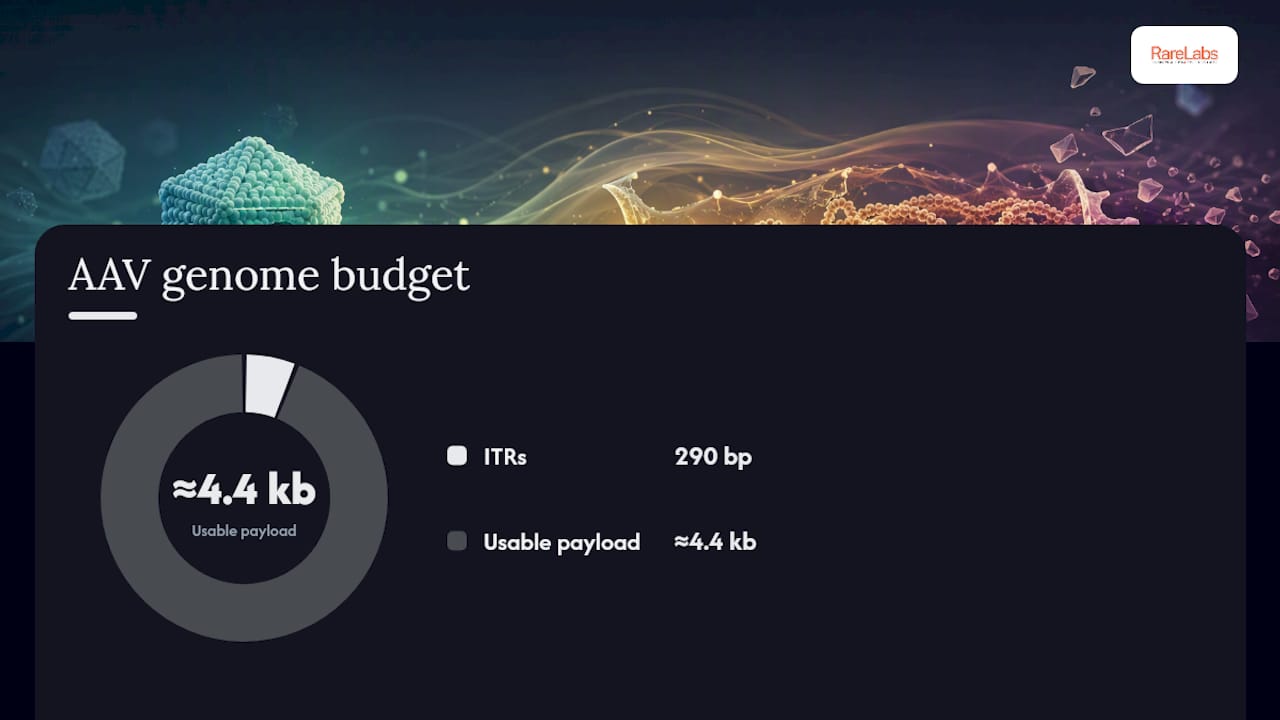
Two ITRs eat into that budget before you've written a single line of your expression cassette. Each ITR runs about 145 base pairs, so roughly 290 bp of the total 4.7 kb ceiling is non-negotiable structural sequence with no room for the transgene itself. That leaves you working with somewhere around 4.4 kb of usable payload once you also budget for a promoter, a polyA signal, and any regulatory elements you need. Researchers who calculate capacity using the "4.7 kb" headline number and then are surprised when their finished plasmid comes in over budget have usually forgotten to reserve space for the ITRs in the first place.
Serotype does introduce some variability, though not enough to meaningfully move the ceiling. Different AAV serotypes (AAV2, AAV5, AAV8, AAV9, and others) share the same basic capsid architecture and roughly comparable internal volume, so packaging capacity doesn't shift dramatically across serotypes the way tropism does. Where serotype differences show up is in how the vector behaves once genome size approaches the limit. Some capsids tolerate oversized cargo with a smaller drop in yield than others, which is part of why serotype selection belongs in the same design conversation as cassette trimming. Engineering approaches that modify capsid surface loops or swap VP1/VP2 ratios have been explored to shift tropism and stability, but none has produced a serotype with a substantially larger genuine packaging ceiling. The 4.7 kb boundary is structural, not sequence-dependent, and no amount of codon optimization changes the physics of the shell.
What Happens to Genome Integrity Past 4.9–5.0 kb
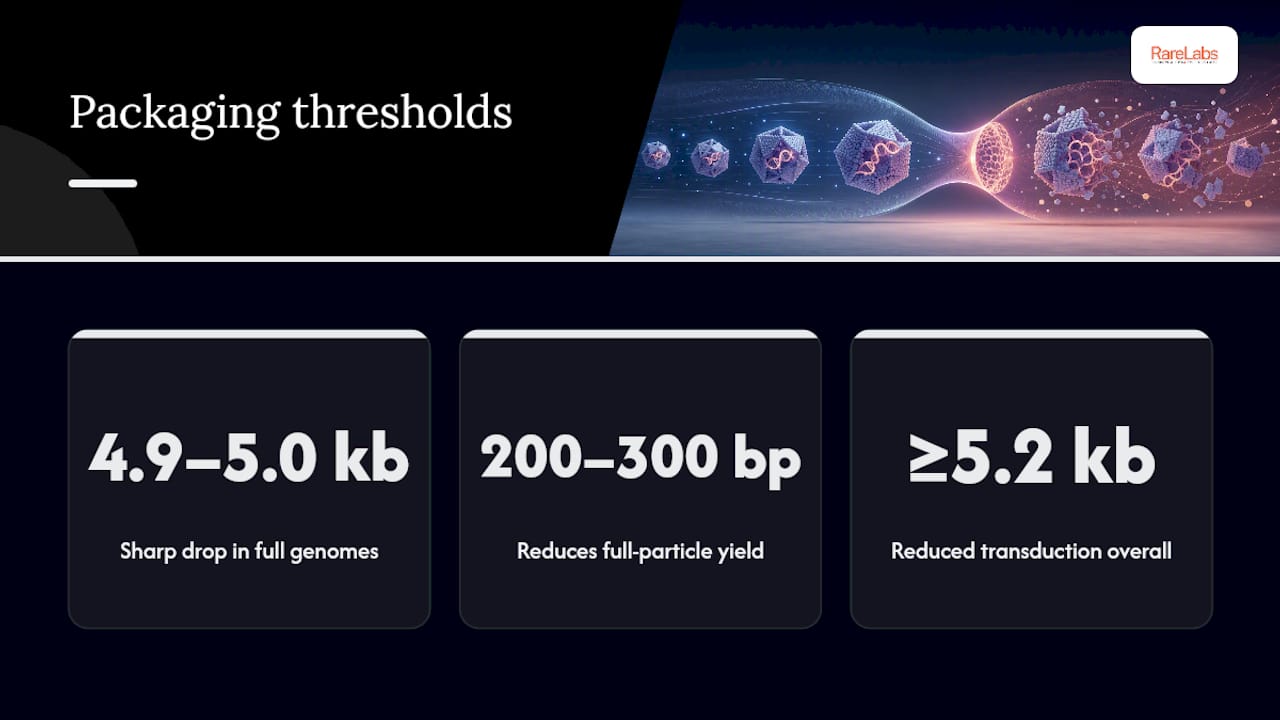
Here's the finding that should change how you read every capacity claim above 5 kb: long-read nanopore sequencing shows a sharp drop in the proportion of full-length genomes right around 4.9 to 5.0 kb, with each oversized construct producing its own reproducible truncation pattern rather than random fragmentation. That reproducibility is the interesting part. It suggests the packaging machinery doesn't just fail randomly when it runs out of room. It fails in a construct-specific, predictable way, which means two labs packaging the same oversized cassette should see similar truncation signatures if they sequence deeply enough.
The core statistic to remember: full-length genome proportion falls sharply in the narrow 4.9–5.0 kb window, based on long-read sequencing data — meaning a genome just 200 to 300 bases over the practical ceiling can already show a meaningfully worse full-particle yield than one that fits comfortably under it.
The functional consequence trips up a lot of researchers who rely on expression assays alone. Truncated genomes aren't necessarily dead genomes. Sequencing data indicate that truncation often preserves regulatory or reporter regions preferentially over the full open reading frame, meaning a construct can still light up in a fluorescence assay or qPCR expression readout even when the majority of packaged particles carry an incomplete genome. If your only QC checkpoint is "does it express," you can miss a serious full-length packaging failure hiding underneath an apparently successful result.
This also explains why oversized genomes correlate with reduced infectivity even when some particles clearly transduce cells. Work on serotype-specific packaging capacity found that vectors carrying genomes larger than about 5.2 kb transduce less efficiently overall, and that proteasome inhibitors can partially rescue transduction in cell culture, a finding that points toward degradation-related bottlenecks rather than simple failure to enter the cell. That rescue effect is an experimental tool, not a clinical option. It tells you the mechanism involves post-entry processing, not a usable fix for production.
The practical downstream effect is a shift in your full-to-empty particle ratio and a corresponding increase in lot-to-lot variability. A batch built around a 4.5 kb cassette will generally show a more consistent full-particle percentage across production runs than a batch built around a 5.3 kb cassette, where small variations in transfection efficiency or cell health can swing the full fraction meaningfully. That variability has direct consequences for potency assignment and dosing consistency, which is exactly the kind of critical quality attribute regulators expect you to characterize before you scale up.
Split-Vector and Mini-Gene Strategies for Oversized Transgenes
Once your cassette clears roughly 4.7 kb even after trimming, you're choosing between splitting the payload across two AAVs or shrinking the payload to fit one. Neither option is free, and the right call depends heavily on how tolerant your target protein is to fragmentation and how much efficiency loss your application can absorb.
- Overlapping vectors. Two AAVs each carry part of the transgene with a shared homologous sequence at the junction, and intracellular recombination stitches the halves back together. Recombination efficiency depends heavily on overlap length, typically several hundred base pairs, and even well-optimized overlaps rarely reconstitute full-length product as efficiently as a single intact vector. This approach is straightforward to design but the least efficient of the three main split strategies.
- Trans-splicing vectors. Each half-genome carries a splice donor or splice acceptor site, and the cell's own splicing machinery joins the transcripts after transduction. Some designs use protein-level intein splicing instead of RNA splicing, chemically ligating two half-proteins after independent translation. Trans-splicing tends to outperform simple overlap recombination, but it requires the transgene to tolerate a split at a splice-compatible junction, which isn't always where you'd choose to cut.
- Hybrid vectors. These combine a short homologous overlap region with a splicing element, aiming to get the reliability of homologous recombination and the joining precision of splicing at once. Reviews of dual-vector approaches generally rank hybrid designs above pure overlap strategies for reconstitution efficiency, though they add a layer of design complexity.
- Concatemer-driven and sequential reassembly approaches. These rely on the natural tendency of AAV genomes to form head-to-tail concatemers in the nucleus, sometimes paired with homology-directed repair strategies to encourage precise joining rather than random recombination. These are less standardized than overlapping or trans-splicing designs and tend to be construct-specific in performance.
Before committing to a split-vector strategy, consider whether a single-vector fix solves the problem more cleanly. Mini-gene approaches (using a naturally occurring shorter isoform of your target protein), aggressive codon optimization to shrink the coding sequence, and compact regulatory elements (short synthetic promoters and minimal polyA signals) can sometimes claw back enough space to stay under 4.7 kb without splitting anything. When the transgene genuinely can't be trimmed or split without losing function, it's worth stepping outside AAV altogether. Lentiviral vectors carry substantially larger payloads, and non-viral delivery methods avoid the packaging ceiling entirely, though both trade away AAV's low immunogenicity and long clinical track record.
Pro Tip: Before scaling up any split-vector design, run a co-infection dose titration at multiple ratios (start around 1:1 and test up to 3:1) and confirm reconstitution with a junction-spanning PCR or western blot for the full-length product, not just an expression readout. A positive expression signal can appear even when full reconstitution rates are low, and you want to know your true efficiency before committing production resources to it.
If you're weighing whether a split-vector approach or an entirely different delivery platform makes more sense for your target gene, our overview of gene therapy approaches for ultra-rare disease programs walks through how that decision typically gets made in early feasibility work.
Manufacturing Consequences: Yield, Purity, and Regulatory Benchmarks
Genome size doesn't just affect what gets packaged. It reshapes your entire production and purification workflow. Specific productivity across rAAV manufacturing platforms is commonly benchmarked around 10^5 vector genomes per cell, but that figure assumes a reasonably well-packaged genome. Push cassette size toward the ceiling and full-particle yield tends to drop even when total particle tier looks normal, because more of what you're producing is empty or truncated capsid rather than genuine, potent product.
Production platform choice compounds this effect. Comparative work on rAAV manufacturing shows that the percentage of full particles at harvest varies widely depending on whether you're using transient triple transfection, stable producer cell lines, or baculovirus-based insect cell systems, with transient transfection frequently landing on the lower end of that range. If you're already fighting a packaging efficiency penalty from an oversized genome, a low-full-fraction production platform stacks a second penalty on top of it, and the combination can turn a marginal construct into an unmanufacturable one.
Regulatory expectations don't bend for large-genome constructs, and that's where oversized cassettes create real downstream risk.
- The FDA's residual DNA guidance for biological products generally expects residual cellular DNA under roughly 10 ng per parenteral dose.
- For transient transfection processes specifically, a practical benchmark for residual plasmid DNA sits around 100 ng per 1×10^12 vector genomes.
- Both benchmarks come from broader regulatory and safety guidance on residual DNA in biological products, and they apply regardless of how large or small your packaged genome is.
Oversized cassettes make these limits harder to hit because reverse packaging, where the vector plasmid backbone itself gets encapsidated instead of just the ITR-flanked cassette, becomes more likely as your cassette leaves less "spare" ITR to ITR distance for the packaging machinery to respect. One practical fix backed by production pharmacology research: increasing the plasmid backbone size beyond the packaging capacity reduces reverse packaging substantially, with one study reporting roughly a 7.6 fold decrease in plasmid-derived contaminants using a larger backbone design. Placing any potentially hazardous sequences (antibiotic resistance genes, bacterial origin of replication) as far from the ITRs as possible reinforces that same protective effect.
For lot release and stability testing on large-genome constructs, lean on AUC and ddPCR for full/empty quantification, and add long-read sequencing whenever you suspect truncation risk, since standard qPCR won't catch it. Reviews on AAV drug product formulation increasingly frame packaging capacity as a continuous critical quality attribute rather than a pass/fail cutoff, which is the right mental model for anyone designing a lot release strategy around a construct sitting near the ceiling. If your process consistently underperforms on full-particle percentage, switching from transient transfection to a producer cell line or baculovirus system is worth evaluating before you assume the construct itself is unmanufacturable.
A Design Checklist for Cassettes Near the AAV Packaging Limit
Getting a large-genome construct through feasibility and into a clean manufacturing run comes down to catching problems in the design phase rather than discovering them in a sequencing report six months later.
- Calculate total cassette size including both ITRs, not just the transgene and regulatory elements. Budget roughly 290 bp for ITRs alone, then add promoter, coding sequence, and polyA before comparing your total against the 4.7 kb ceiling.
- Choose the smallest functional promoter and polyA signal your expression needs allow. Compact synthetic promoters can save several hundred base pairs over a full-length native promoter without necessarily sacrificing expression strength.
- Codon-optimize and trim non-essential coding sequence, checking for naturally occurring shorter isoforms of your target protein that retain the function you need.
- Select a backbone plasmid larger than the packaging capacity to reduce reverse packaging risk, and place any bacterial resistance genes away from the ITRs.
- Confirm serotype choice based on tropism and reported oversized-genome tolerance, not purely on historical convention for your disease area.
- Run small-scale production first, then quantify full particles with AUC or ddPCR before investing in a larger batch.
- Sequence with long-read nanopore methods to map truncation patterns directly rather than inferring genome integrity from expression alone.
- Confirm function with in vitro assays that measure the intended protein product, not just a reporter or expression proxy that could be produced by a truncated genome.
- Run a small in vivo pilot before committing to scale-up, watching specifically for the dose-potency mismatches that oversized, variable-full-fraction lots tend to produce.
- Set a clear decision point for abandoning single-vector AAV if full-particle yield or sequencing data show consistent truncation, and pivot to a split-vector or non-AAV platform before sinking further resources into a single oversized construct.
Pro Tip: Set your abandon-single-vector decision point before you start production, not after a disappointing sequencing report. Decide in advance, for example, that a full-length genome proportion below a defined threshold on long-read sequencing triggers an automatic pivot to a split-vector design. Making that call under pressure after a failed run almost always costs more time than building the fallback plan up front.
If you're mapping out that broader decision tree between AAV modification, split-vector engineering, and alternative platforms, the gene therapy evaluation framework covers how those tradeoffs typically get weighed in a feasibility assessment for ultra-rare disease programs.
How Hopeatrarelabs Supports Feasibility Work on Large-Gene Constructs
When a transgene is approaching or exceeding the AAV packaging limit, the question quickly shifts from vector design to feasibility: does a split-vector or alternative delivery strategy actually reconstitute function in patient-relevant cells before you commit to a full manufacturing run? Some specialized biotech providers build patient-derived iPSC models and run parallel screens across repurposed drugs, custom ASOs, and gene therapy feasibility work, which supports testing reconstitution efficiency and potency readouts on split-vector designs in disease-relevant cell backgrounds rather than generic cell lines. That kind of early functional data, paired with translational support toward Pre-IND planning, helps researchers decide whether to push forward with a large-genome AAV strategy, switch to a dual-vector approach, or explore a non-AAV platform like the ASO strategies or ex vivo approaches that fit certain ultra-rare targets better than AAV ever will.
Selected Primary Sources and Further Reading
For readers who want to go directly to the source data behind the numbers in this article: the foundational capacity and infectivity work appears in Packaging Capacity of Adeno-Associated Virus Serotypes and its companion postentry infectivity study. The long-read sequencing methodology behind the truncation findings is detailed in this nanopore-based packaging evaluation. Dual-vector mechanisms are reviewed in Expressing Transgenes That Exceed AAV Capacity, and production and regulatory benchmarks come from rAAV production pharmacology, manufacturing systems reviews, and residual DNA regulatory guidance.
Why the 4.7 kb Number Gets Treated as More Rigid Than It Is
The literature isn't actually contradictory once you separate what each study measured from what it claimed. A 6 kb encapsidation report and a 4.7 kb capacity figure aren't in conflict. One measured DNA mass; the other measured verified full-length sequence. The mistake researchers keep making is treating packaging capacity as a single number to design against, rather than a curve where infectivity, genomic integrity, and full-particle yield all decline at different rates as you approach and cross 4.7 kb.
Conventional advice tends to stop at "keep it under 4.7 kb," which is true but incomplete. It doesn't tell you that a 4.9 kb cassette isn't simply 200 bases over budget, it's sitting in the exact window where full-length genome proportion collapses fastest. It also doesn't tell you that expression data alone can't confirm full-length packaging, since truncated genomes preferentially retain regulatory regions.
If there's one priority to take from this, it's sequencing before scaling. Long-read data on your actual construct will tell you more about real-world capacity than any published capacity range ever will.
— John
This article is general information, not a substitute for advice from a qualified doctor. Consult a qualified healthcare professional about your own circumstances before acting on anything here.