

CRISPR gene editing is defined as a precise, programmable technology that modifies DNA sequences by using a guide RNA molecule to direct the Cas9 enzyme to a specific location in the genome, where it makes a targeted cut. This technology, adapted from bacterial immune defense systems, gives scientists the ability to delete, correct, or insert genetic information with a level of accuracy that older methods could not match. The discovery of CRISPR's programmable RNA-guided DNA-cutting mechanism earned Jennifer Doudna and Emmanuelle Charpentier the 2020 Nobel Prize in Chemistry. For students and curious learners, understanding CRISPR means understanding one of the most consequential tools in modern biology.
What is CRISPR gene editing at the molecular level?
CRISPR stands for Clustered Regularly Interspaced Short Palindromic Repeats. These are sequences naturally found in bacterial genomes, where they serve as a kind of genetic memory of past viral infections. When a virus attacks, bacteria use CRISPR sequences paired with Cas proteins to recognize and cut the viral DNA, neutralizing the threat. Scientists recognized that this natural system could be repurposed as a general-purpose editing tool for any organism.
The core mechanism works in three steps. First, researchers design a short guide RNA (gRNA) that matches the DNA sequence they want to edit. Second, the gRNA binds to the Cas9 enzyme and escorts it through the genome until it finds the matching DNA sequence. Third, Cas9 makes a double-strand break, cutting both strands of the DNA helix at that precise location.

What happens after the cut determines the type of edit. The cell detects the break and activates one of two repair pathways. NHEJ and HDR pathways produce very different outcomes: Non-Homologous End Joining (NHEJ) is fast but error-prone, often creating small insertions or deletions that disable a gene. Homology-Directed Repair (HDR) is slower but precise, using a provided DNA template to insert a specific sequence. Researchers choose between these pathways depending on whether they want to knock out a gene or correct it.
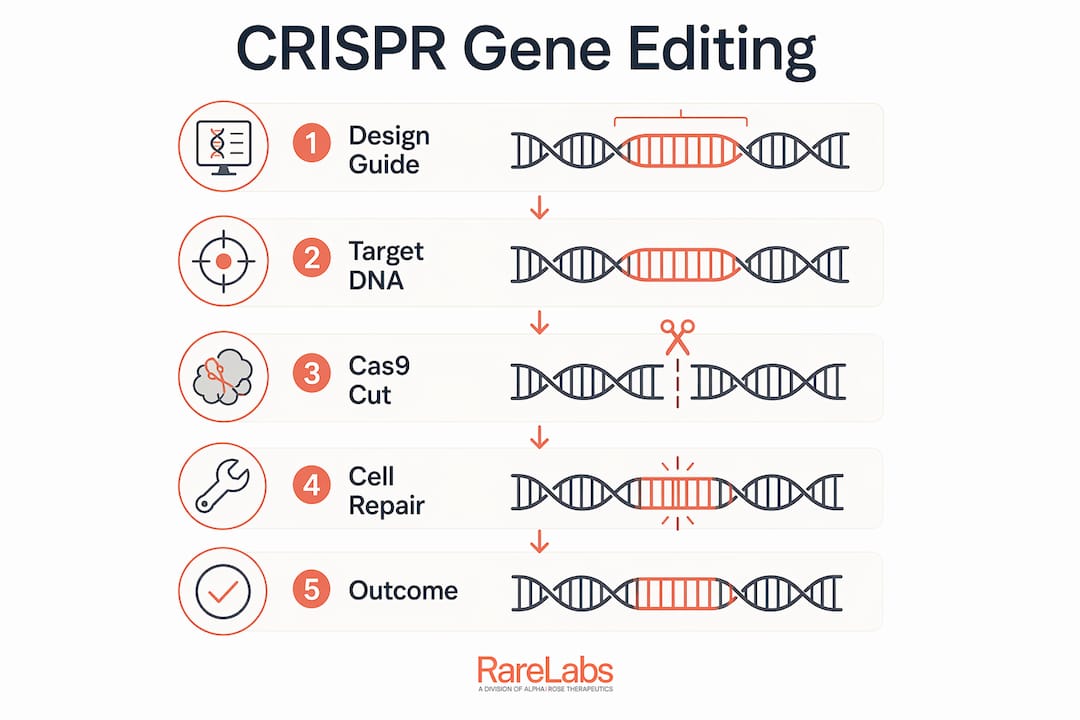
The programmability of the guide RNA is what makes CRISPR so powerful. Changing the target requires only redesigning a short RNA sequence, not rebuilding the entire protein machinery. This flexibility is why CRISPR's rapid adoption transformed genetics research within just a few years of its introduction.
Newer methods have extended the original system further. Prime editing, for example, uses a modified Cas9 paired with a pegRNA and a reverse transcriptase enzyme to write new genetic information directly into the genome without double-stranded breaks. This approach broadens the range of editable mutations and may reduce unintended side effects compared to standard Cas9 cutting.
Pro Tip: When reading about CRISPR experiments, pay attention to which repair pathway was used. An experiment relying on NHEJ will produce different results than one using HDR, even if the guide RNA targets the same gene.
What are the major applications of CRISPR today?
CRISPR is used across biomedical research, agriculture, and drug discovery, making it one of the most versatile tools in science. The breadth of its applications reflects how quickly the technology moved from laboratory curiosity to real-world use.
Here are the major areas where CRISPR is making a measurable difference:
-
Treating genetic diseases. The FDA has approved CRISPR-based therapies for sickle cell disease and beta thalassemia, marking the first time gene editing has been used as a clinical treatment. In 2023, Children's Hospital of Philadelphia treated the world's first patient with a fully personalized CRISPR therapy designed for a single individual's unique mutation. This signals a shift from population-level treatments to patient-specific medicine.
-
Biomedical research and disease modeling. Scientists use CRISPR to create cell lines and animal models that replicate human diseases. This allows researchers to study conditions like Alzheimer's disease, Huntington's disease, and rare genetic disorders in ways that were previously impossible or prohibitively expensive. Hopeatrarelabs uses this approach directly, building patient-specific disease models from a patient's own cells to test potential therapies for ultra-rare conditions.
-
Cancer immunotherapy. Researchers are editing immune cells, particularly T cells, to make them more effective at recognizing and destroying cancer cells. Clinical trials using CRISPR-edited T cells are underway for several cancer types, with early results showing promise.
-
Agriculture and food security. CRISPR has been used to develop crops with improved disease resistance, drought tolerance, and longer shelf life. The USDA has approved several CRISPR-edited crops that do not require the same regulatory pathway as traditional GMOs, accelerating their path to market.
-
Drug discovery and genetic screening. Genome-wide CRISPR screens allow researchers to systematically disable thousands of genes and observe the effects, identifying which genes are responsible for specific biological functions or disease states. This approach has accelerated the identification of drug targets significantly.
Exploring genetic therapies for rare diseases shows how CRISPR sits at the center of a broader shift toward treating the genetic root cause of disease rather than managing symptoms.
What safety and ethical challenges exist in CRISPR editing?
CRISPR's precision is real, but it is not perfect. Off-target editing occurs when Cas9 cuts at unintended sites in the genome that share partial similarity with the guide RNA sequence. In a therapeutic context, an off-target edit in a tumor suppressor gene could have serious consequences. This remains the most significant technical barrier to broader clinical use.
The field has developed several strategies to address these risks:
- High-fidelity Cas9 variants. Engineered versions of Cas9, such as eSpCas9 and HiFi Cas9, carry mutations that reduce tolerance for mismatches between the guide RNA and the target DNA, lowering off-target activity without sacrificing on-target efficiency.
- Guide RNA design tools. Software platforms analyze the genome to predict and rank potential off-target sites before an experiment begins. Careful guide RNA design, including attention to PAM sequence requirements, is one of the most effective ways to minimize off-target effects.
- Detection methods. Techniques like GUIDE-seq and CIRCLE-seq allow researchers to map off-target cuts across the entire genome after editing, providing a safety profile for any given guide RNA.
- Stepwise experimental controls. Effective CRISPR experimental design uses controls that distinguish delivery failures from guide design problems or editing chemistry errors, making it easier to identify the source of unexpected results.
Beyond the technical challenges, ethics and safety are not just scientific problems. They are societal ones. The 2018 announcement that a Chinese researcher had edited human embryos to confer HIV resistance shocked the scientific community and led to international calls for a moratorium on heritable human genome editing. Regulatory bodies in the United States and Europe have since developed clearer frameworks, but the question of where to draw the line on human germline editing remains unresolved.
Pro Tip: When evaluating any CRISPR therapy or research claim, ask whether the study measured off-target effects and which detection method was used. Studies that skip this step are incomplete, regardless of how promising the on-target results appear.
For a grounded look at how these ethical challenges intersect with clinical practice, the discussion of gene editing for rare diseases offers useful context.
How does CRISPR compare to older gene editing tools?
Before CRISPR, scientists used zinc finger nucleases (ZFNs) and Transcription Activator-Like Effector Nucleases (TALENs) to edit genomes. Both tools work by attaching a DNA-cutting enzyme to a protein that recognizes a specific DNA sequence. They were functional but slow, expensive, and technically demanding to design. Each new target required engineering an entirely new protein, a process that could take months and cost tens of thousands of dollars.
CRISPR replaced protein-based targeting with RNA-based targeting. Because RNA is far cheaper and faster to synthesize than custom proteins, CRISPR's RNA-guided system reduced the cost and time of genome editing by orders of magnitude. A guide RNA that would have taken months to develop as a protein can now be designed in minutes using free online tools and ordered for delivery within days.
| Feature | ZFNs / TALENs | CRISPR-Cas9 |
|---|---|---|
| Design complexity | High (protein engineering required) | Low (RNA sequence design) |
| Cost per target | Very high | Low to moderate |
| Time to develop | Weeks to months | Days to weeks |
| Multiplexing (editing multiple genes at once) | Difficult | Straightforward |
| Off-target risk | Present | Present, actively being reduced |
| Clinical use | Limited | FDA-approved therapies exist |
CRISPR is not without limitations relative to older tools. Some studies suggest that ZFNs, when properly optimized, can achieve higher specificity at certain loci. Delivery of the CRISPR machinery into specific tissues in the body also remains a challenge, particularly for organs like the brain and heart. But the speed, cost, and flexibility advantages of CRISPR have made it the dominant platform for both research and therapeutic development. The latest genomic medicine breakthroughs reflect how thoroughly CRISPR has reshaped the field in under a decade.
Key takeaways
CRISPR gene editing works because its RNA-guided Cas9 system combines programmable targeting with cellular repair mechanisms to produce precise, reproducible changes to DNA across virtually any organism.
| Point | Details |
|---|---|
| Core mechanism | Guide RNA directs Cas9 to a specific DNA site, where a cut triggers NHEJ or HDR repair. |
| Nobel-recognized breakthrough | Jennifer Doudna and Emmanuelle Charpentier won the 2020 Nobel Prize for CRISPR's development. |
| FDA-approved therapies | CRISPR treatments for sickle cell disease and beta thalassemia are now clinically approved. |
| Safety remains a priority | Off-target editing is the primary technical risk, addressed through high-fidelity Cas9 variants and guide RNA design. |
| CRISPR vs. older tools | CRISPR outpaces ZFNs and TALENs in speed, cost, and versatility, though delivery challenges persist. |
Why CRISPR's real test is still ahead
I have followed CRISPR's development closely since the early papers from the Doudna and Charpentier labs, and the speed of adoption genuinely surprised me. What took protein-based editing tools a decade to accomplish in the lab, CRISPR replicated in two or three years and then pushed further. The programmability is the key insight. You are not redesigning a machine every time you change a target. You are writing a new address label for the same machine.
That said, I think the field sometimes undersells how hard the remaining problems are. Delivery is the bottleneck that does not get enough attention in popular coverage. Getting CRISPR into the right cells in a living human, in sufficient quantities, without triggering an immune response, is an engineering challenge that rivals the editing itself. Lipid nanoparticles work well for the liver. They do not work well for the brain or muscle tissue, and those are exactly the tissues where many rare genetic diseases cause the most damage.
Prime editing is the development I watch most carefully right now. The ability to make precise edits without creating double-strand breaks removes one of the biggest sources of unintended consequences in standard Cas9 editing. If delivery methods catch up to the editing chemistry, the therapeutic possibilities expand considerably.
The ethical dimension is not going away either. Somatic cell editing, which changes only the treated patient's cells, is broadly accepted. Germline editing, which would pass changes to future generations, is a different conversation entirely. The scientific community needs clear, enforceable international standards before that line gets crossed again.
For students entering this field, my advice is to learn the biology deeply but also engage with the policy and ethics literature. The scientists who will shape CRISPR's future most constructively are the ones who understand both.
— John
Explore CRISPR and rare disease research with Hopeatrarelabs
Hopeatrarelabs sits at the intersection of CRISPR technology and rare disease medicine. The team builds patient-specific disease models using iPSCs and CRISPR gene editing, then runs parallel treatment screens across thousands of FDA-approved drugs, custom antisense oligonucleotides, and gene therapy options. For patients, families, and physicians navigating ultra-rare or undiagnosed genetic conditions, this approach offers a structured, scientifically rigorous path toward finding viable treatment options. Visit the RareLabs Knowledge hub to access expert resources on rare disease research, genetic therapy options, and the latest CRISPR-based approaches being developed for conditions that currently have no approved treatments.
FAQ
What does CRISPR stand for?
CRISPR stands for Clustered Regularly Interspaced Short Palindromic Repeats, referring to the repetitive DNA sequences found in bacterial genomes that form the basis of the natural immune defense system scientists adapted into a gene editing tool.
How long does a CRISPR editing experiment take?
A basic CRISPR editing experiment in cell culture typically takes one to four weeks from guide RNA design to confirmed editing results, depending on the cell type, delivery method, and detection assay used.
Is CRISPR gene editing permanent?
Edits made to somatic cells are permanent within those cells and their descendants, but they are not passed to future generations. Germline edits, made in embryos or reproductive cells, would be heritable, which is why international scientific bodies have called for strict limits on that application.
What is the difference between NHEJ and HDR in CRISPR editing?
NHEJ is a fast but imprecise repair pathway that often introduces small insertions or deletions, typically used to disable a gene. HDR is a precise pathway that uses a DNA template to insert a specific sequence, used when an exact correction is needed.
Are there approved CRISPR therapies available today?
The FDA has approved CRISPR-based therapies for sickle cell disease and beta thalassemia, and personalized CRISPR treatments for individual patients with unique mutations are advancing through clinical development at institutions like Children's Hospital of Philadelphia.