
Duchenne muscular dystrophy (DMD) is an X-linked, progressive muscle-wasting disease caused by mutations in the DMD gene that disrupt production of dystrophin, a protein muscles need to stay intact. According to the CDC, it is one of the most common and severe forms of muscular dystrophy, affecting roughly 1 in 3,500 male births worldwide. There is currently no universal cure, but modern multidisciplinary care has meaningfully extended survival and quality of life.
Here are the core facts to know:
- Who it affects: Almost exclusively boys; girls are typically carriers and rarely show symptoms.
- When symptoms start: Usually between ages 2 and 4, often noticed as delayed walking, frequent falls, or toe walking.
- What drives it: A faulty or absent dystrophin protein causes muscle cell membranes to break down progressively.
- How it progresses: Most boys lose the ability to walk by around age 12; cardiac and respiratory complications follow in the teens and twenties.
- Current care: Steroids, cardiac monitoring, and respiratory support slow decline but do not reverse it. Several mutation-specific drugs now carry FDA approval for eligible patients.
Key Takeaways
Duchenne muscular dystrophy is an X-linked disease affecting roughly 1 in 3,500 boys, and knowing the exact mutation type is the single most important factor in accessing current and emerging therapies.
| Point | Details |
|---|---|
| Incidence and who it affects | DMD affects ~1 in 3,500 male births; girls are usually carriers and rarely symptomatic. |
| Mutation type determines treatment | ~70% of cases involve exon deletions; the specific exon affected determines eligibility for approved exon-skipping drugs. |
| Modern care extends survival | Multidisciplinary care including ventilation and cardiac management has shifted median survival into the thirties for many patients. |
| Get exon-level genetic detail | Ask for the exact exon(s) affected in the genetic report; this is required for trial and therapy eligibility screening. |
| Connect with a care team and advocacy | Enroll with a multidisciplinary clinic, contact Parent Project Muscular Dystrophy, and check ClinicalTrials.gov for mutation-matched trials. |
Table of Contents
- Key DMD statistics at a glance
- What causes Duchenne: the dystrophin gene and X-linked inheritance
- How symptoms appear and progress over time
- How DMD is diagnosed
- Current treatments and how they work
- How life expectancy has changed
- Where DMD research is heading
- Living with Duchenne: building your care team and finding support
- Why genotype details matter more than most families realize
- Sources
Key DMD statistics at a glance
The numbers below come from the NIH Genetics Home Reference and StatPearls, two of the most cited sources in clinical DMD literature.
| Metric | Figure | Why it matters |
|---|---|---|
| Incidence | ~1 in 3,500 male births | Makes DMD one of the most common X-linked diseases |
| Caused by exon deletions | ~70% of cases | Deletion location determines exon-skipping drug eligibility |
| Caused by duplications | ~10% of cases | Some duplications also respond to skipping strategies |
| Caused by point mutations | ~20% of cases | May respond to stop-codon read-through agents |
| De novo (new) mutations | about one-third of cases | Means no family history does not rule out DMD |
| Typical symptom onset | Ages 2–4 | Early recognition shortens the diagnostic delay |
| Loss of ambulation | Often by age ~12 | Marks transition to non-ambulatory care phase |
The single most important number: roughly 1 in 3,500 boys is born with DMD, placing it among the most prevalent X-linked genetic diseases globally.
The mutation-type breakdown matters beyond statistics. A boy whose genetic report shows an exon 51 deletion may be eligible for eteplirsen (Exondys 51), while one with an exon 53 deletion might qualify for golodirsen (Vyondys 53). Knowing the exact exon affected is not a paperwork detail; it is the gateway to specific therapies.
What causes Duchenne: the dystrophin gene and X-linked inheritance
The DMD gene, located on the X chromosome, carries instructions for making dystrophin, a long rod-shaped protein that anchors muscle fibers to their surrounding structure. Without functional dystrophin, repeated muscle contractions tear cell membranes faster than the body can repair them. Over time, muscle tissue is replaced by fat and scar tissue, and function is lost permanently.
Because the DMD gene sits on the X chromosome, the inheritance pattern is X-linked recessive:
- Boys (XY) have only one X chromosome. A single faulty copy of the gene means no backup, so they develop the disease.
- Girls (XX) typically carry one working copy and one faulty copy. The working copy usually compensates, so most carriers have no symptoms, though a small number experience mild muscle weakness due to a process called skewed X-inactivation.
- about one-third of cases arise from spontaneous new mutations, meaning the mother is not a carrier and there is no prior family history.
Mutation types break down roughly as follows:
- approximately 70% exon deletions — one or more exons are missing, disrupting the reading frame
- roughly 10% exon duplications — extra copies of exons shift the reading frame similarly
- about 20% point mutations or small insertions/deletions — single-letter changes or tiny sequence errors, sometimes creating a premature stop codon
Why does mutation type matter so much? Because several approved and investigational therapies work only on specific mutation types. A deletion of exon 50, for example, responds differently than a deletion of exon 45. Genetic counseling and precise mutation identification are not optional extras; they are the foundation of a treatment plan.
How symptoms appear and progress over time
DMD does not announce itself dramatically at birth. The first signs are subtle enough that many families spend months wondering whether their child is simply a late developer.
Ages 2–4: Early motor signs. Parents often notice toe walking, a waddling gait, difficulty climbing stairs, or more falls than other children the same age. A classic early finding is Gowers' sign: when asked to stand from the floor, the child pushes hands against thighs and "walks" hands up the legs to compensate for weak hip and thigh muscles. Calf muscles often look unusually large and firm, a feature called pseudohypertrophy. Despite the impressive appearance, those calves are not strong. Fat and fibrous tissue have replaced functional muscle, creating a misleading look of bulk while actual strength declines.
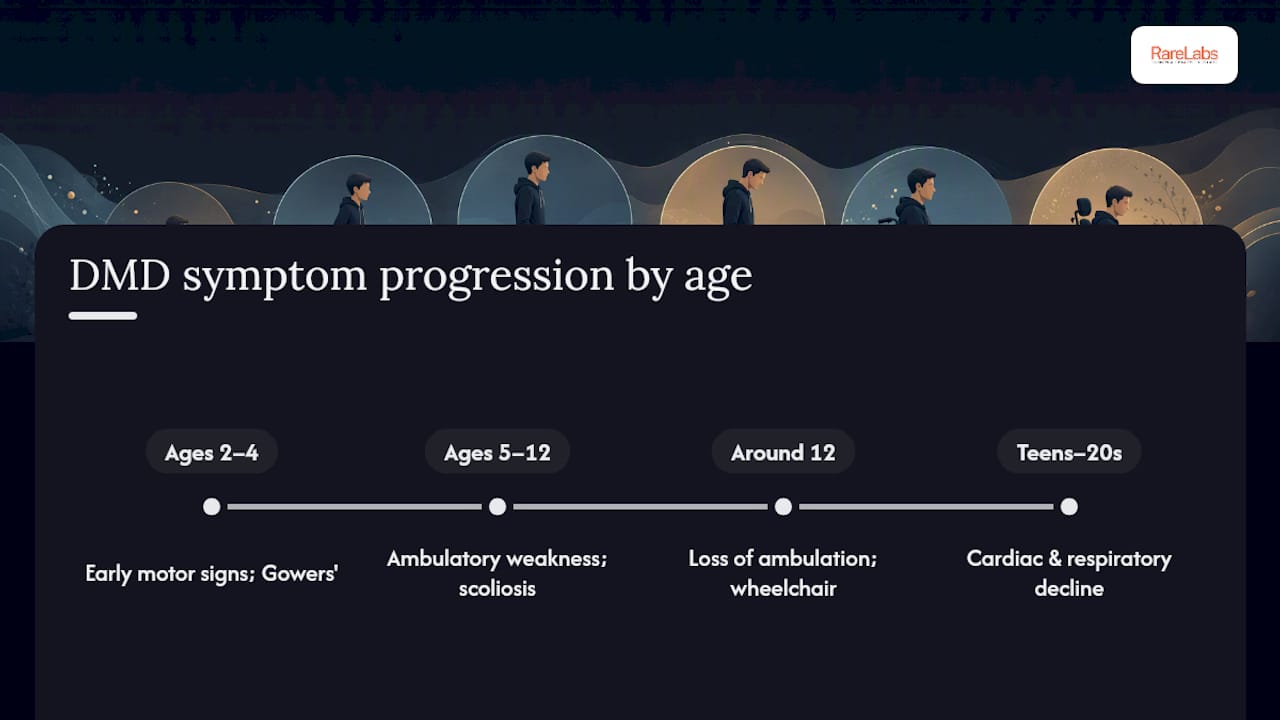
Ages 5–12: Ambulatory phase. Weakness spreads from the hips and thighs to the shoulders and arms. Running becomes labored, stairs require railings, and falls increase. Scoliosis can develop as spinal muscles weaken. Fractures occur in a meaningful proportion of patients, partly from falls and partly because glucocorticoid therapy affects bone density. The Merck Manual notes fractures in a substantial minority of patients in some clinical series.
Early teens: Loss of ambulation. Most boys transition to a wheelchair by around age 12, though glucocorticoid treatment can delay this by two to three years in some cases. Once ambulatory ability is lost, scoliosis tends to accelerate, and the focus of care shifts heavily toward spinal, cardiac, and respiratory management.
Teens and twenties: Cardiopulmonary complications. Cardiomyopathy develops in virtually all patients with DMD by their teens. Respiratory muscle weakness follows, requiring noninvasive ventilation, typically at night first, then more continuously. A subset of boys also experience learning difficulties or intellectual disability, unrelated to motor severity, because dystrophin is expressed in the brain as well as muscle.
How DMD is diagnosed
Diagnosis usually begins with a blood test. Creatine kinase (CK), an enzyme that leaks from damaged muscle cells, is dramatically elevated in DMD, often 10 to 100 times the normal upper limit. A very high CK in a young boy with motor delays is a strong signal to refer to a pediatric neurologist.
The diagnostic pathway from there:
- CK blood test confirms muscle damage is occurring.
- Genetic testing identifies the exact mutation. Multiplex ligation-dependent probe amplification (MLPA) detects deletions and duplications efficiently. For cases where MLPA is negative, next-generation sequencing finds point mutations and small variants.
- Muscle biopsy is used less often now that genetic testing is so sensitive, but it can confirm absent dystrophin protein by immunostaining when genetic results are ambiguous.
- Carrier testing for mothers and female relatives uses the same genetic methods and is important for family planning.
Early and precise genetic diagnosis matters for two reasons beyond confirming the disease. First, it determines which mutation-specific therapies or clinical trials the patient may be eligible for. Second, it gives the family accurate information for reproductive decisions.
Pro Tip: When you receive a genetic report, ask the clinician or genetic counselor to specify exactly which exon or exons are affected, not just the mutation category. Many mutation-specific therapies and trial eligibility criteria are defined at the exon level, and a report that says only "deletion" without naming the exon is not enough to check eligibility.
Current treatments and how they work
No treatment today reverses DMD. What current care does is slow the progression, protect the heart and lungs, and extend both lifespan and functional independence. The Merck Manual and StatPearls both classify the standard of care as palliative, meaning it manages the disease rather than curing it.
Glucocorticoids are the cornerstone of treatment:
- Prednisone and deflazacort (Emflaza) are the two most commonly used steroids. Both slow muscle function decline and can delay loss of ambulation.
- Steroids are typically started between ages 4 and 6, when the child is in the plateau phase of motor development, before significant decline begins.
- Side effects (weight gain, bone density loss, behavioral changes) require monitoring and management alongside the drug itself.
Cardiac and respiratory care is equally critical:
- Cardiology surveillance usually begins by age 6 and continues at least annually. ACE inhibitors or beta-blockers are started when early cardiomyopathy appears, sometimes prophylactically.
- Noninvasive ventilation (such as BiPAP) is introduced when respiratory muscle weakness causes nighttime hypoventilation, typically in the mid-teens for boys not on steroids and somewhat later for those who are.
Physical therapy, occupational therapy, and orthopedic care preserve function and prevent contractures. Scoliosis surgery may be needed once the curve progresses beyond a threshold that compromises breathing.
Mutation-specific therapies represent a newer and more targeted layer of treatment. The FDA has approved several exon-skipping antisense oligonucleotides for specific mutation subgroups:
- Eteplirsen (Exondys 51) targets exon 51 skipping
- Golodirsen (Vyondys 53) targets exon 53
- Casimersen (Amondys 45) targets exon 45
Each drug applies to a narrow slice of the DMD population, and clinical evidence for functional benefit remains an active area of evaluation. These are not cures, but they represent the first generation of mutation-matched molecular therapies for DMD.
Practical timeline: Steroids typically start at ages 4–6; cardiology surveillance by age 6; respiratory monitoring in early teens; ventilatory support introduced as needed based on pulmonary function tests.
How life expectancy has changed
Historically, DMD was associated with death in the late teens or early twenties, almost always from respiratory failure. That picture has shifted substantially. Improvements in respiratory and cardiac care, including noninvasive ventilation and proactive use of cardiac medications, have correlated with longer survival and improved quality of life. Many patients receiving modern multidisciplinary care now survive into their thirties and forties, according to NCBI review data.
The two leading causes of death remain cardiomyopathy and respiratory failure, but the timeline for each has been pushed back meaningfully by surveillance and intervention. A boy diagnosed today, started on steroids, enrolled in a multidisciplinary clinic, and monitored closely for cardiac and respiratory changes has a substantially different prognosis than one diagnosed two decades ago.
The shift in one sentence: Modern ventilation support and cardiac management have moved median survival from the late teens into the thirties for many patients with DMD.
What this means practically: the goal of care is no longer simply to extend life but to preserve function, independence, and quality of life for as long as possible. That requires a care team that coordinates across neurology, cardiology, pulmonology, orthopedics, and rehabilitation, not a single specialist managing the disease in isolation.
Where DMD research is heading
The research picture for DMD is more active than for almost any other rare neuromuscular disease. Several directions are advancing simultaneously.
Gene replacement therapy aims to deliver a shortened but functional version of the dystrophin gene (a "micro-dystrophin") using viral vectors. The FDA's first gene therapy approval for DMD marked a significant milestone, though eligibility is currently limited to younger ambulatory patients and long-term data are still accumulating. For a deeper look at how gene therapy platforms work across rare diseases, the gene therapy approaches guide from Hopeatrarelabs covers the mechanisms clearly.
Antisense oligonucleotide (ASO) exon skipping is the basis for the approved drugs above and for a growing pipeline of investigational agents. The principle: a short synthetic DNA-like molecule "masks" a faulty exon so the cell skips over it during protein production, restoring a partial but functional reading frame. Custom ASOs are also being developed for patients with ultra-rare or private mutations not covered by any commercial drug.
Stop-codon read-through agents like ataluren (not FDA-approved in the US but approved in some other markets) target the roughly 10–15% of DMD patients whose mutation creates a premature stop codon.
Utrophin upregulation takes a different approach entirely: rather than fixing or bypassing the dystrophin gene, it tries to boost production of utrophin, a related protein that can partially substitute for dystrophin.
Patient-derived iPSC disease models are an emerging precision tool. A lab takes cells from a specific patient, reprograms them into induced pluripotent stem cells, differentiates those into muscle cells carrying the patient's exact mutation, and uses that model to screen hundreds or thousands of compounds. This approach is especially valuable for patients with rare or private mutations where no commercial therapy exists. StatPearls highlights personalized iPSC modeling and custom ASO development as a growing frontier in translational DMD research.
Here is how the process typically flows for a patient with a private mutation:
- Genetic report identifies a rare or unique exon variant
- Patient-derived cells are reprogrammed into iPSCs and differentiated into DMD muscle cells
- The model is used to screen repurposed FDA-approved drugs and custom ASOs in parallel
- Hits are ranked and shared with the clinical team for further evaluation or compassionate use consideration
Pro Tip: Ask your neurologist or genetic counselor whether your child's specific mutation is covered by any active clinical trial. ClinicalTrials.gov allows you to filter by disease and mutation type. For mutations not covered by commercial drugs or open trials, ask whether a specialized lab offers personalized disease modeling or custom ASO screening. Hopeatrarelabs, for example, runs exactly this kind of patient-specific program for ultra-rare and private variants.
For families weighing experimental options, the parent guide to gene therapy from Hopeatrarelabs walks through what to expect and how to evaluate risk.
Living with Duchenne: building your care team and finding support
DMD is a multi-system disease, and no single specialist can manage it well alone. The CDC and published Duchenne care considerations both emphasize multidisciplinary clinics as the standard of care. A complete care team typically includes:
- Pediatric neurologist — leads diagnosis, monitors motor progression, coordinates steroid management
- Cardiologist — manages cardiomyopathy surveillance and treatment
- Pulmonologist — monitors respiratory function and manages ventilatory support
- Physical and occupational therapists — preserve function, prevent contractures, recommend adaptive equipment
- Orthopedic surgeon — manages scoliosis and fracture risk
- Genetic counselor — explains inheritance, guides carrier testing, and reviews trial eligibility
- Social worker or psychologist — supports the family's emotional and practical needs
Practical next steps for families:
- Request a full genetic report with exon-level detail and ask for a referral to a genetic counselor if you have not already seen one.
- Enroll in a patient registry. The NIH Genetic and Rare Diseases Information Center links to registries and trial databases.
- Connect with Parent Project Muscular Dystrophy (PPMD), the leading US advocacy organization for DMD families. PPMD maintains care guidelines, a trial finder, and a community network.
- Ask the school district about an Individualized Education Program (IEP) or Section 504 plan if learning difficulties or physical accommodations are needed.
- Check ClinicalTrials.gov for mutation-specific trials and ask the care team whether your child's genotype qualifies.
For families exploring personalized research options, the Hopeatrarelabs knowledge hub is a practical starting point for understanding what patient-specific disease modeling and drug screening programs involve.
Why genotype details matter more than most families realize
Most articles about DMD cover the basics well: what the disease is, how it progresses, which drugs exist. What they underemphasize is how much the specific mutation, down to the exact exon or nucleotide, determines what options are actually available to a given patient.
The approved exon-skipping drugs each cover a narrow slice of the DMD population. Gene therapy trials have their own eligibility windows, often tied to age, ambulation status, and mutation type simultaneously. Custom ASO programs and iPSC-based drug screens are designed around the patient's exact genetic variant. A family that knows only "my son has a deletion" is working with a fraction of the information they need.
The other thing worth saying plainly: the shift toward personalized medicine in DMD is real, but it is not evenly distributed. Families at major academic medical centers with dedicated neuromuscular programs tend to get genotype-matched care. Families in smaller communities often do not, not because the options do not exist, but because no one has connected the dots between the genetic report and what it unlocks. That gap is worth closing, and it starts with asking the right questions.
Sources
NIH Genetic and Rare Diseases Information Center (GARD): Patient-facing summaries, registry links, and trial databases for DMD. rarediseases.info.nih.gov
CDC — About Muscular Dystrophy: Public-health overview and links to Duchenne care considerations. cdc.gov/muscular-dystrophy
NIH Genetics Home Reference: Incidence figures, mutation-type breakdown, and inheritance explanation. genome.gov
StatPearls — Duchenne Muscular Dystrophy (NCBI Bookshelf): Clinical overview covering diagnosis, treatment, and emerging research. ncbi.nlm.nih.gov/books/NBK482346
Merck Manual Professional Edition: Clinical features, glucocorticoid evidence, fracture risk, and surveillance recommendations. merckmanuals.com
FDA — First Gene Therapy Approval for DMD: Official press release on mutation-specific gene therapy approval. fda.gov
This article is general information, not a substitute for advice from a qualified doctor. Consult a qualified healthcare professional about your own circumstances before acting on anything here.
- Genetics Home Reference: Duchenne muscular dystrophy
- Duchenne Muscular Dystrophy - StatPearls - NCBI Bookshelf
- Duchenne Muscular Dystrophy and Becker Muscular Dystrophy - Merck Manual Professional Edition
- About Muscular Dystrophy | Muscular Dystrophy | CDC
- FDA approves first gene therapy treatment for certain patients with Duchenne muscular dystrophy