

Yes, you can build a patient registry, and the path runs through ten linked decisions rather than one big technical project. The core sequence goes: define your purpose, map your stakeholders, lock down governance, design a lean dataset, choose a platform that fits your budget and scale, then run operations and pursue sustainable funding.
- Articulate the purpose and research questions first
- Confirm a registry is the right tool for the job
- Identify stakeholders and build a governance structure
- Define scope, core dataset, and outcomes
- Choose a platform and secure funding before enrolling anyone
Pro Tip: Resist the urge to collect everything you might someday want. The registries that survive year three are the ones that started with a core dataset of 20 to 30 fields, not 200.
Key Takeaways
Building a usable patient registry depends on defining a narrow purpose, establishing governance before data collection begins, and adopting standardized data elements from day one.
| Point | Details |
|---|---|
| Start with purpose | Write a one-paragraph purpose statement before designing any data collection form. |
| Build governance early | Establish a steering committee and data access policy before enrolling participants. |
| Keep the dataset lean | Limit the core dataset to fields tied directly to your research questions, then stage expansion. |
| Adopt standard terminologies | Use SNOMED CT, LOINC, ICD, or CDISC codes to keep data interoperable and shareable. |
| Plan sustainability upfront | Combine grants, contracts, and partnerships rather than relying on a single funding source. |
Where to Find Templates and Further Guidance
- NCATS RaDaR toolkit: step-by-step templates for rare disease registries
- AHRQ/PCORI user's guide: the methods and standards reference behind the ten-step framework
- Patient organization educational guide: practical lessons from real first-time registry builders
Table of Contents
- What Is a Patient Registry and When Should You Build One?
- Steps to Establish a Patient Registry: A Ten-Step Checklist
- How Do You Set Up Governance and Handle Consent?
- What Data Elements and Standards Should You Use?
- Which Technical Platform and Security Controls Do You Need?
- How Do You Recruit and Retain Registry Participants?
- What Operational Protocols Keep Data Quality High?
- What Drives Registry Costs and Long-Term Sustainability?
- A Rare Disease Registry Case: What We Learned Building One
- What Does a Data Governance and Management Plan Look Like?
- What Does a Realistic Registry Timeline Look Like?
- How Do You Train Staff to Use the Registry Correctly?
- How Should You Plan Data Analysis and Reporting?
- How Should Patients Be Involved in Registry Design?
- Frequently Asked Questions
- Sources
What Is a Patient Registry and When Should You Build One?
A patient registry is an organized observational system that collects uniform clinical and other data to evaluate specified outcomes for a defined population, according to the AHRQ/PCORI user guide's definition. It is not a database you fill and forget. It is infrastructure built to answer a specific question over time.
Registries typically serve four purposes: tracking natural history of a disease, assessing treatment safety or effectiveness, monitoring care quality, and supplying regulatory evidence when a randomized trial is not feasible, a role the European Medicines Agency formally recognizes for post-authorization safety monitoring.
- Disease registries: track a condition's course across a population, often the starting point for rare disease research
- Product or device registries: monitor real-world performance of an approved therapy or implant
- Procedure or episode registries: follow outcomes tied to a specific intervention
- Quality improvement registries: benchmark care processes across sites
Steps to Establish a Patient Registry: A Ten-Step Checklist
Most successful registries follow a sequence close to the ten-step framework laid out in the AHRQ/PCORI Registries for Evaluating Patient Outcomes user's guide. Adapt the order to your situation, but do not skip steps.
- Articulate your purpose. Write one paragraph stating what question the registry answers and for whom. This becomes your north star when scope creep shows up later.
- Confirm a registry is appropriate. Sometimes a clinical trial, a claims analysis, or an existing dataset already answers your question more cheaply.
- Identify stakeholders. List patients, clinicians, foundations, and potential data users before you write a line of code. Deliverable: a one-page stakeholder map.
- Assess feasibility and funding. Estimate enrollment potential, staffing needs, and a realistic multi-year budget.
- Build your core team. You need at minimum a principal investigator, a data manager, and a coordinator, even in a lean startup registry.
- Establish governance. Draft a charter defining who approves data access and publications. Deliverable: a governance charter.
- Define scope and rigor. Decide inclusion criteria and how strictly you will verify data quality.
- Select the core dataset and outcomes. Deliverable: a draft data dictionary tied directly to your research questions.
- Develop your study protocol. This documents enrollment, follow-up schedule, and data handling procedures.
- Create a project management plan. Set milestones, a realistic timeline, and named owners for each task.
Pro Tip: Stage your registry in phases rather than launching the full vision on day one. Pilot with a narrow core dataset, measure the burden on your data collectors, then expand. Registry builders who set expectations too high early on frequently stall, according to an educational guide for patient organizations built on both US and European registry experience.
How Do You Set Up Governance and Handle Consent?
Governance is not paperwork you finish and shelve. It is the mechanism that keeps a registry trustworthy enough for clinicians to enroll patients and for biopharma partners to eventually use the data.
- A steering committee that sets scientific direction and resolves disputes
- A data access committee that reviews external requests against your governance charter
- Named data steward roles with explicit responsibility for data quality and security
- Conflict-of-interest declarations for anyone with publication or commercial access rights
- A written publications policy clarifying authorship and data-use credit
Consent models range from broad consent, covering future unspecified research uses, to dynamic consent, where participants approve each new use as it arises. Either model requires IRB or ethics committee review and, often, a formal data-sharing agreement before any external party touches the dataset. Registries that actively partner and share data reduce fragmentation across the field, a point the NCBI's overview on registry information sharing makes directly.
Pro Tip: Draft your data-sharing agreement template before you need it. Scrambling to write one when a biopharma partner asks for access costs you months.
What Data Elements and Standards Should You Use?
Choose data elements based on what your research questions actually require, not what seems interesting to collect. Every field you add is a field a coordinator has to enter and a patient has to provide, so weigh value against burden for each one.
- Separate core fields (mandatory, tied to your primary question) from optional fields (nice to have, collected only if resources allow)
- Select outcome measures tied directly to your stated research questions, not generic quality-of-life scales unless they answer something specific
- Adopt recognized terminologies where possible: SNOMED CT for clinical findings, LOINC for lab results, ICD codes for diagnoses, and CDISC standards if you anticipate regulatory submission
- Build a formal codebook and data dictionary from day one
The AHRQ user's guide is direct on this point: standardized outcome measures and defined data elements are what let a registry's data be combined with others down the line. Skip the codebook and you inherit an unusable dataset in three years.
Which Technical Platform and Security Controls Do You Need?
Your platform choice depends on scale, budget, and how much you need to integrate with existing clinical systems.
- Lightweight field apps work for small, single-site registries with modest budgets but limited integration
- EHR-integrated registries pull structured data automatically, reducing manual entry but requiring IT resources to build
- Enterprise research platforms scale to multi-site, international registries but carry higher licensing and maintenance costs
Interoperability increasingly runs through APIs and FHIR-based data exchange, letting a registry pull structured records from an electronic health record, lab system, or device feed rather than relying on manual re-entry. A structured intake and integration approach, like the one outlined in this playbook on centralizing patient records, applies directly to registry data pipelines.
Security basics are non-negotiable: encryption at rest and in transit, role-based access controls, audit logging, and periodic security testing. Cross-border registries also need to account for data residency rules and consider Zero Trust security architecture from the start, a consideration flagged in Springer's guide to building an online patient registry.
How Do You Recruit and Retain Registry Participants?
Recruitment usually works best through multiple simultaneous channels rather than one.
- Clinic-based enrollment during routine visits
- Partnerships with patient advocacy groups and foundations, especially valuable for rare disease populations
- EHR-triggered outreach based on diagnosis codes
- Online outreach and referral networks
Keep eligibility screening short and consent language in plain terms; a complicated onboarding process kills enrollment before it starts. For retention, combine scheduled reminders, flexible data-collection modes (phone, app, in-person), and genuine two-way feedback so participants see their input matters. Our guide to rare disease research for patients and partners covers stakeholder engagement tactics specific to small, geographically dispersed populations.
What Operational Protocols Keep Data Quality High?
Operational discipline is what separates a registry that produces publishable findings from one that produces noise.
- Write SOPs covering eligibility confirmation, enrollment, the follow-up schedule, and adverse event handling.
- Build validation rules directly into your data entry forms to catch errors at the source.
- Run source-data verification on a sample of records regularly, not just at audit time.
- Set up a monitoring dashboard tracking completeness, timeliness, and inconsistency rates.
- Assign a named quality-assurance owner who reviews these metrics monthly, not annually.
What Drives Registry Costs and Long-Term Sustainability?
Personnel costs typically dominate a registry budget, followed by platform licensing, compliance and security overhead, data curation, and participant engagement activities.
- Mixed funding models (grants plus fee-for-service contracts) outlast single-source grant funding
- Paid, governance-transparent data access for qualified biopharma or academic partners can fund ongoing operations
- Foundation partnerships often cover startup costs while a registry builds a track record
Before committing, run a quick feasibility check: do you have a realistic enrollment path, a two-year budget, and at least one committed data steward? If any answer is no, address it before writing your first protocol.
A Rare Disease Registry Case: What We Learned Building One
At Hopeatrarelabs, our work modeling ultra-rare and undiagnosed genetic diseases has meant supporting registry-adjacent data collection for small patient populations, often fewer than 100 known cases worldwide. One recurring pattern: teams that started with a narrow core dataset, tight governance tied to a single steering committee, and recruitment through advocacy group partnerships moved faster than teams that tried to build a comprehensive dataset upfront.
- Starting small preserved data quality; a 15-field core dataset got completed consistently, a 60-field one did not
- Prioritizing governance and standards early avoided a costly re-architecture at month 18
Pro Tip: If you are modeling a rare or undiagnosed condition, align your registry's core dataset with the phenotypic detail a future disease-modeling program would need. It saves duplicate data collection later.
What Does a Data Governance and Management Plan Look Like?
A data governance plan is the document that survives staff turnover. Without one written down, institutional knowledge about who can access what walks out the door when your data manager leaves.
At minimum, name a data steward responsible for day-to-day data quality, access requests, and codebook maintenance. This role differs from your principal investigator, who owns scientific direction, and your IT lead, who owns infrastructure. Blurring these three roles is a common early mistake that creates bottlenecks once your registry grows past a single site.
Your governance plan should specify: who can request data extracts and under what conditions, how amendments to the data dictionary get approved, retention periods for source documents, and what happens to the dataset if funding lapses. Build in a version-control process for your data dictionary itself. Fields get added, redefined, or retired as research questions evolve, and a registry with three years of undocumented dataset changes becomes nearly impossible to analyze longitudinally.
Data stewardship also covers de-identification standards for any data leaving your core system, and a documented process for handling participant requests to withdraw or amend their information. Write these procedures into your governance charter alongside the steering committee structure, not as a separate afterthought document nobody references.
What Does a Realistic Registry Timeline Look Like?
Most registries move through four overlapping phases rather than a strict sequential path. Planning and governance setup typically take four to six months for a single-site, disease-specific registry, longer for multi-site or international projects requiring coordinated ethics approvals across jurisdictions.
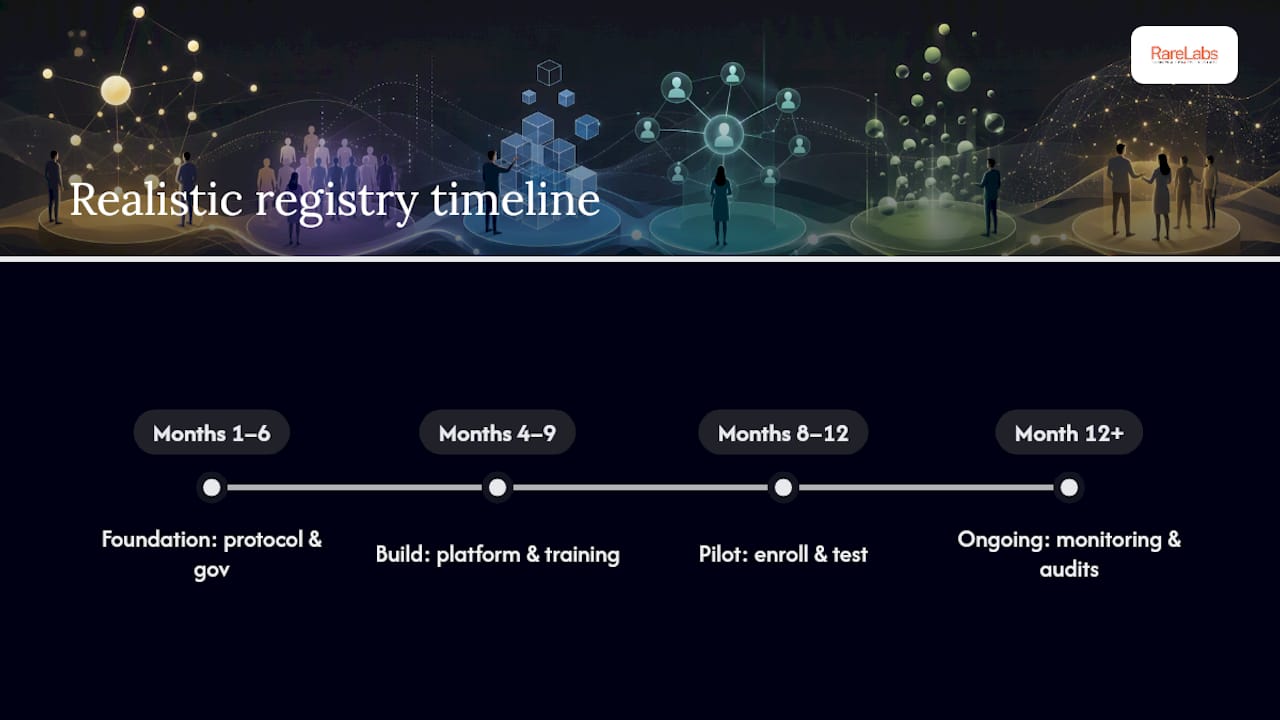
Phase one, foundation (months 1 to 6): purpose statement, stakeholder mapping, governance charter, and IRB submission happen in parallel. Deliverable: an approved protocol and a governance document ready for signature.
Phase two, build (months 4 to 9, overlapping with phase one): platform selection, data dictionary finalization, and staff training run concurrently. Many teams underestimate this phase because platform configuration and data dictionary revisions tend to loop back on each other repeatedly.
Phase three, pilot and launch (months 8 to 12): enroll a small initial cohort, stress-test your data collection forms, and fix workflow problems before scaling. This is where the staged approach pays off; a pilot of 20 to 30 participants surfaces usability problems that would otherwise appear across your full cohort.
Phase four, ongoing operations (month 12 onward): full enrollment, routine monitoring, periodic data quality audits, and your first analysis cycle. Build in a review milestone at month 18 to reassess whether your original dataset still matches your research questions.
How Do You Train Staff to Use the Registry Correctly?
Training is not a one-time kickoff meeting. Data entry errors traced back to unclear instructions are among the most common, and most preventable, sources of registry data quality problems.
Build role-specific training rather than a single generic session. Coordinators entering data day to day need hands-on practice with your actual forms and edge cases, not just a slide deck. Clinicians providing source data need a short reference sheet explaining exactly which fields matter and why, since busy clinical staff will not read a full protocol document. Data managers need deeper training on the codebook, validation rules, and how to handle discrepancies flagged by your monitoring dashboard.
Document every training session and require a brief competency check before granting data entry access, particularly for multi-site registries where consistency across sites determines whether pooled analysis is even valid. Refresh training whenever the data dictionary changes; a field redefinition that goes uncommunicated to one site creates a silent data quality problem that can take months to detect.
How Should You Plan Data Analysis and Reporting?
Write your analysis plan before you collect your first data point, not after you have a dataset to explore. A registry without a predefined analysis plan tends to drift toward whatever questions the data happens to answer well, which undermines the scientific credibility you built governance and standards to protect.
Your analysis plan should state your primary research question, the outcome measures that answer it, and the statistical approach you intend to use, including how you will identify and address potential sources of bias in an observational dataset. Selecting outcomes and sample size should trace directly back to your primary analytic questions, with an explicit plan for quantifying and mitigating bias built into the protocol itself.
Build a reporting cadence into your operations from the start: an internal quarterly summary for your steering committee, an annual report for funders and stakeholders, and a plan for peer-reviewed publication once you hit meaningful enrollment or follow-up milestones. Decide in advance who has authorship rights and how interim findings get communicated to participants, since transparency here directly affects retention and trust.
How Should Patients Be Involved in Registry Design?
Patient input belongs in the design phase, not just the recruitment phase. Registries built entirely by clinicians and researchers, without patient input on what data collection actually feels like, tend to underestimate participant burden until enrollment numbers reveal the problem.

Involve patient representatives or advocacy group leaders when you draft your core dataset and consent language. They will flag questions that feel intrusive or redundant long before your IRB does. For rare disease registries specifically, patient organizations often hold institutional knowledge about the condition's natural history that no published literature captures yet, making their early involvement a scientific asset, not just an ethical one.
Structure ongoing patient involvement through a standing seat on your steering committee or a separate patient advisory panel with real influence over protocol amendments. Our guide to patient rights in rare disease care covers consent and data rights considerations that should inform how you structure this involvement from the start.
A Closing Note on Getting Started
The stepwise approach works because it forces hard decisions early, when they are cheap to fix, instead of after eighteen months of data collection. If you are weighing whether to build a registry for an ultra-rare condition, the resources linked throughout this guide are a solid starting point.
Frequently Asked Questions
How long does it take to build a patient registry? A single-site disease registry typically takes four to six months for planning and governance setup, with pilot enrollment starting around month eight to twelve. Multi-site or international registries take longer due to coordinated ethics review.
What is the minimum team needed to start a patient registry? At minimum, you need a principal investigator, a data manager, and a coordinator. Larger or multi-site registries add a data steward, biostatistician, and dedicated IT support.
Do I need IRB approval to build a patient registry? Yes, virtually all patient registries collecting identifiable health information require ethics or IRB review, along with a defined consent model before enrollment begins.
What is the difference between a patient registry and a clinical trial? A registry is observational; it tracks outcomes as they occur naturally without assigning treatments, while a clinical trial actively assigns interventions to test their effect.
How do I fund a patient registry long term? Most sustainable registries combine initial grant funding with fee-for-service contracts, foundation partnerships, or governance-transparent paid data access for qualified research partners.
This article is general information, not a substitute for advice from a qualified doctor. Consult a qualified healthcare professional about your own circumstances before acting on anything here.
Sources
- Planning a Registry - Registries for Evaluating Patient Outcomes: A User’s Guide - NCBI Bookshelf
- Patient Registries - Registries for Evaluating Patient Outcomes: A User’s Guide - NCBI Bookshelf
- Building a Registry - NCATS Toolkit - NIH
- So You Want to Build Your Disease’s First Online Patient Registry: An Educational Guide for Patient Organizations Based on US and European Experience - PMC