

Antisense oligonucleotides (ASOs) are short, synthetic nucleotide sequences that bind directly to RNA to modulate gene expression, making them one of the most targeted tools in rare disease treatment development. The role of ASOs in treatment development has expanded rapidly as researchers gain better control over RNA biology at the molecular level. Unlike small molecules that act on proteins, ASOs intercept the genetic message before a disease-causing protein is ever made. Ionis Pharmaceuticals and AstraZeneca have both built major research programs around this mechanism, recognizing that ASOs can reach targets that conventional drugs cannot.
What molecular mechanisms enable ASOs to influence disease treatment?
ASOs bind with high specificity to mRNA or pre-mRNA, either triggering degradation of the target transcript or altering how it is spliced. Both outcomes change the amount or type of protein a cell produces. That single capability opens the door to treating diseases caused by toxic protein gain, protein deficiency, or aberrant splicing.

The two primary mechanisms work differently at the cellular level. Degradation-based ASOs recruit RNase H, an enzyme that cleaves the RNA strand in an RNA-DNA hybrid. Splicing-modulating ASOs, by contrast, physically block splice sites or branch points on pre-mRNA, redirecting the spliceosome to include or skip specific exons. Spinal muscular atrophy (SMA) treatment with nusinersen works exactly this way, restoring functional SMN protein by correcting splicing of the SMN2 gene.
A third mechanism involves steric blocking of translation, where the ASO simply sits on the mRNA and prevents ribosomes from reading it. Each mechanism targets a distinct step in gene expression. Researchers working on targeted therapies for rare genetic disorders can therefore select the mechanism that best fits the biology of a specific disease.
- RNase H-mediated degradation: Reduces total transcript levels; useful for loss-of-function rescue when a mutant allele must be silenced.
- Splice-switching: Redirects exon inclusion or exclusion without destroying the transcript; critical for diseases like DMD where exon skipping restores a reading frame.
- Steric blocking: Prevents ribosome access or miRNA binding; applicable when translation suppression is the therapeutic goal.
Pro Tip: When designing an ASO program, confirm which mechanism your target biology requires before selecting chemistry. Choosing an RNase H-competent gapmer for a splice-switching application will degrade the transcript you intended to redirect.
What are the main challenges in ASO treatment development?
The treatment development process for ASOs faces four core barriers: nuclease degradation in biological fluids, poor uptake into target cells, rapid renal clearance, and off-target binding to unintended RNA sequences. Each barrier reduces the fraction of administered ASO that reaches its intended site of action.
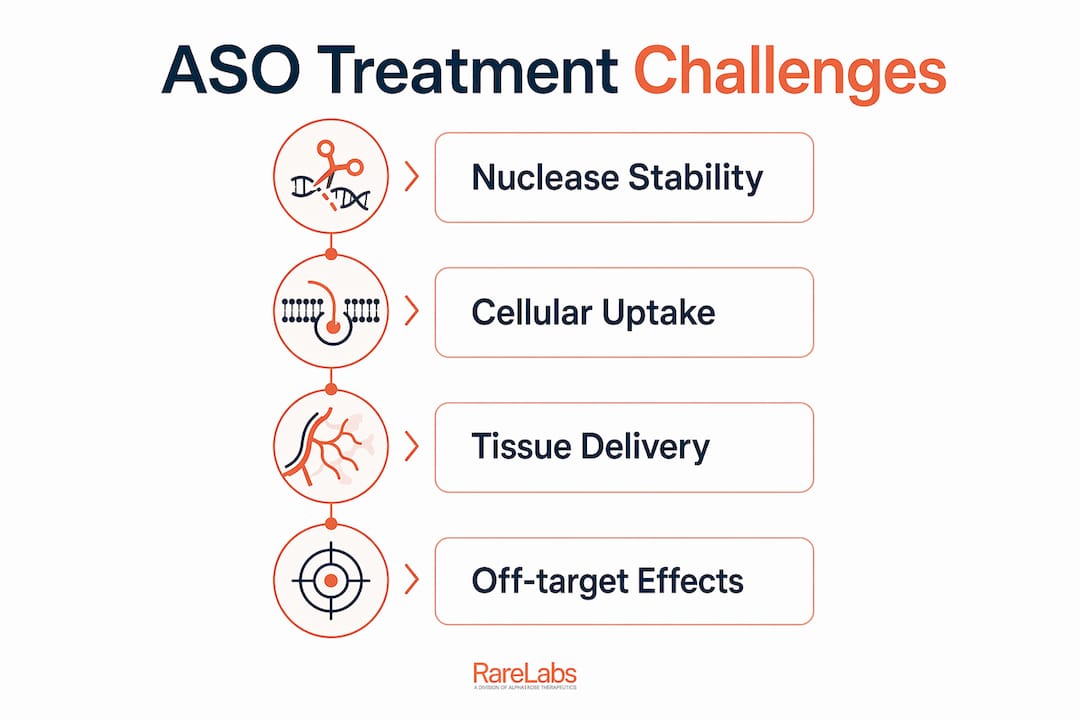
Chemical modifications to the sugar-phosphate backbone address the first two problems directly. Phosphorothioate (PS) backbone substitutions replace a non-bridging oxygen with sulfur, dramatically increasing nuclease resistance and plasma half-life. Locked nucleic acid (LNA) and 2'-O-methoxyethyl (2'-MOE) sugar modifications increase binding affinity to the target RNA, allowing shorter, more specific sequences to be used.
Delivery to non-hepatic tissues remains the most significant unresolved challenge. GalNAc conjugation has made liver targeting highly efficient by exploiting the asialoglycoprotein receptor on hepatocytes. Researchers at AstraZeneca are actively working to identify equivalent ligands for neurons, muscle cells, and lung epithelium. Until those ligands are validated, systemic or intrathecal delivery remains the default for non-liver targets.
A less discussed but serious concern is DNA repair interference. ASOs can disrupt cellular DNA repair by binding DNA repair enzymes and triggering false repair signals, forming dense nuclear clusters called PS bodies. This effect has been observed at concentrations used in research settings and represents a real design constraint for next-generation molecules.
The numbered steps below reflect the standard sequence researchers use to address these barriers:
- Select backbone chemistry based on target tissue and required mechanism (PS, LNA, 2'-MOE, or combinations).
- Optimize sequence specificity using bioinformatics to minimize off-target RNA binding before synthesis.
- Choose a delivery strategy matched to target tissue: GalNAc conjugation for liver, intrathecal injection for CNS, inhaled delivery for lung.
- Screen for PS body formation early in the program to flag sequences with high DNA repair interference risk.
- Validate pharmacokinetics in vivo before advancing to efficacy studies.
"Ensuring exact target sequence match in preclinical models is a major determinant of translational success." This principle from preclinical model selection research explains why many ASO programs fail at the transition from animal studies to human trials.
Pro Tip: Run a BLAST search against the full transcriptome of your model organism before ordering your first ASO batch. A single off-target hit in a housekeeping gene can confound every downstream efficacy readout.
How do ASOs compare to other genetic therapies in rare disease treatment?
ASOs offer broader clinical application potential than gene therapies because they can modulate expression without permanently altering the genome. That reversibility is both a safety feature and a practical advantage when the optimal dose or target is still being defined. Gene therapies, by contrast, offer permanent correction but carry integration risks and are generally limited to one administration.
The table below compares the two modalities across the dimensions most relevant to rare disease programs.
| Feature | ASOs | Gene therapy |
|---|---|---|
| Genomic alteration | None | Permanent (in most formats) |
| Reversibility | Yes, effect fades as drug clears | No |
| Target scope | RNA (any expressed gene) | DNA or RNA |
| Delivery complexity | Moderate | High (viral vectors) |
| Redosing | Required | Typically single dose |
| Undruggable targets | Yes | Limited |
ASOs are particularly valuable for treating undruggable targets where no small molecule binding site exists on the protein. They can also silence dominant-negative alleles while leaving the wild-type copy intact, a feat that gene replacement cannot accomplish. Combined approaches, where an ASO suppresses a toxic allele while a gene therapy delivers a functional copy, are now entering preclinical evaluation for several ultra-rare conditions.
Key advantages of ASOs over gene therapy in rare disease pipelines:
- No viral vector required, removing immunogenicity concerns tied to AAV capsids.
- Dose can be adjusted or discontinued if adverse effects emerge.
- Manufacturing is chemically defined and more reproducible than biological vector production.
- Sequence can be redesigned relatively quickly if a patient carries an atypical variant.
What are practical examples and emerging trends in ASO therapeutics?
ASOs have achieved regulatory approval for rare neurological diseases including SMA (nusinersen, marketed as Spinraza by Biogen) and Duchenne muscular dystrophy (eteplirsen and golodirsen). These approvals validated the entire ASO drug development framework and created a template that smaller biotechs now follow for ultra-rare conditions.
The most active area of current innovation is expanding delivery beyond hepatocytes. AstraZeneca's nucleotide-based therapeutics program is focused on identifying new targeting ligands that exploit cell-surface receptors on non-liver tissues. Ionis Pharmaceuticals has a pipeline that spans CNS, cardiovascular, and metabolic diseases, demonstrating how a single chemical platform can address dozens of disease areas once the delivery problem is solved for a given tissue.
Collaborations between pharma companies and academic institutions are accelerating chemistry optimization and clinical translation. University labs bring target biology expertise; pharma partners bring medicinal chemistry and regulatory experience. This division of labor has shortened the time from target identification to first-in-human studies for several rare disease programs.
Emerging trends shaping the next generation of ASO therapeutics include:
- Ligand diversification: Moving beyond GalNAc to receptors expressed on neurons, cardiomyocytes, and renal tubular cells.
- Duplex ASO designs: Using two complementary strands to improve potency and reduce off-target effects.
- AI-assisted sequence screening: Using AI-powered genomics tools to predict off-target binding and PS body risk before synthesis.
- Standardized chemistry platforms: Rationalizing backbone and sugar modifications to create predictable safety and pharmacology profiles across programs.
- Patient-derived cell models: Testing ASO candidates in iPSC-derived neurons or organoids that carry the patient's exact mutation, improving translational confidence before animal studies.
Clinical failure from poor preclinical model selection remains a persistent problem. Sequence mismatches between human and rodent target RNAs mean that a highly potent ASO in mice may show no activity in a human cell. Researchers who build patient-derived models early in the program avoid this trap entirely.
Key Takeaways
ASOs are the most versatile RNA-targeting tool in rare disease treatment development, with approved drugs, a defined chemistry toolkit, and an expanding delivery repertoire.
| Point | Details |
|---|---|
| Core mechanism | ASOs bind mRNA or pre-mRNA to degrade transcripts or redirect splicing, directly changing protein output. |
| Chemistry drives performance | Phosphorothioate and LNA modifications increase nuclease resistance and binding affinity, which are non-negotiable for in vivo activity. |
| Delivery limits reach | GalNAc conjugation solves liver targeting; equivalent ligands for CNS and muscle are the field's top unmet need. |
| Safety requires screening | PS body formation from DNA repair interference must be screened early to avoid late-stage program failures. |
| Model selection is critical | Sequence alignment between human and animal target RNA determines whether preclinical data will translate to the clinic. |
Why ASOs deserve more attention than they get in rare disease pipelines
Most rare disease programs I have reviewed underinvest in ASO chemistry optimization early and then scramble to fix pharmacokinetics after the first in vivo experiment fails. The biology is sound. The chemistry toolkit is mature. The failure mode is almost always a mismatch between the molecule's properties and the delivery environment it faces.
What I find genuinely underappreciated is the reversibility argument. Clinicians and families dealing with ultra-rare diseases often face an all-or-nothing decision with gene therapy. An ASO program gives you the ability to titrate, pause, and redesign. That is not a minor convenience. For diseases where the therapeutic window is narrow or the natural history is poorly understood, reversibility is a core safety feature.
The PS body finding from 2026 research is the kind of result that should change how programs are designed, not just how they are screened. It suggests that phosphorothioate loading needs to be minimized wherever possible, which pushes the field toward higher-affinity modifications that allow shorter sequences with fewer PS linkages. That is a solvable problem, but only if teams treat it as a design constraint from day one rather than a late-stage safety flag.
The programs that will succeed over the next five years are the ones that pair precise molecular design with patient-derived cellular models from the start. Waiting for animal data before building a human-relevant model is a timeline mistake the field can no longer afford.
— John
Hopeatrarelabs: a resource for ASO researchers and clinicians
Rare disease researchers need current, curated data to make fast decisions about ASO program design and target selection. Hopeatrarelabs built its knowledge platform specifically for that need.
The RareLabs Knowledge platform aggregates rare disease research, treatment screening data, and ASO therapeutic information in one place. Researchers can search by disease, gene target, or therapeutic modality to find relevant program data quickly. For clinicians and research teams working on undiagnosed genetic conditions, the platform offers a starting point that would otherwise require weeks of literature review. Hopeatrarelabs designed the resource to support both early-stage target identification and late-stage clinical translation decisions.
FAQ
What are antisense oligonucleotides (ASOs)?
ASOs are short, synthetic nucleotide sequences, typically 15–25 bases long, designed to bind complementary RNA sequences and modulate gene expression through degradation, splicing modification, or translation blocking.
How do ASOs differ from gene therapy?
ASOs modify RNA expression without altering the genome and their effects are reversible as the drug clears, while most gene therapies make permanent genomic changes and are typically administered once.
What diseases have been treated with approved ASO drugs?
Spinal muscular atrophy (nusinersen/Spinraza) and Duchenne muscular dystrophy (eteplirsen, golodirsen) are the most prominent approved ASO indications, establishing clinical proof of concept for the platform.
Why do ASO programs fail in preclinical to clinical translation?
Sequence mismatches between human and animal target RNAs are the leading cause, meaning an ASO that works in a mouse model may show no activity in human cells.
What is the biggest unmet need in ASO delivery?
Efficient delivery to non-hepatic tissues is the field's primary gap. GalNAc conjugation solves liver targeting, but equivalent ligands for neurons, muscle, and lung remain under active development by groups including AstraZeneca.