

Research-grade banking can pass on that minimum set. Clinical or GMP-track work adds residual vector testing, adventitious agent screening, and validated acceptance criteria with full traceability. The checklist below breaks down when to run each test and what "pass" actually means.
TL;DR:
- Clinical-grade lines require additional genetic stability testing and validated potency assays, with many labs outsourcing advanced genomic analysis to specialized providers.
- Marker panels like OCT4 and NANOG are only snapshots and do not prove a cell's ability to differentiate into all three germ layers; functional potency tests are essential.
- Chromosomal abnormalities are the primary cause for late rejection of iPSC lines, making tiered testing with karyotyping, SNP arrays, and eventual WES or WGS critical during development.
- Contamination control, including mycoplasma, sterility, and endotoxin testing, is non-negotiable before releasing lines for downstream applications.
- Small labs should focus on locking down identity, sterility, and genomics first, outsourcing advanced assays as needed, rather than attempting to build all tests in-house upfront.
Table of Contents
- Building the Essential IPSC Quality Control Checklist
- Do Marker Panels Actually Prove Pluripotency?
- Genomic Integrity: How Deep Should You Test?
- Microbiology Testing: What's Non-Negotiable Before Release?
- Validating Assays for GMP: What Changes From Research Use?
- Why Do Batch Effects Sneak Into IPSC Data?
- What Does the Timeline From Reprogramming to Release Look Like?
- What Should Small Labs Actually Prioritize First?
- When Should You Bring In RareLabs for IPSC Quality Control?
- Sources
- FAQ
Building the Essential IPSC Quality Control Checklist
The order matters almost as much as the tests themselves. Run identity confirmation before you invest another dollar in a clone, because a mislabeled or cross-contaminated line invalidates everything downstream.
- Donor and clone STR profiling: run immediately after clone selection to confirm the line matches the donor and rule out cross-contamination between parallel cultures.
- Early morphology and karyotype screen: a quick G-banded check around passage 10 to 15 catches gross chromosomal abnormalities before you sink months into a bad clone.
- Pluripotency marker panel: immunophenotyping for at least two markers, one intracellular (OCT4 or NANOG) and one surface marker (TRA-1-60 or SSEA-4), with a common benchmark of positive expression in more than 70% of cells for master cell banks.
- Sterility and mycoplasma testing: performed at bank creation and again at every subsequent thaw used for downstream experiments or distribution.
- Trilineage potency confirmation: directed differentiation or embryoid body assay, run once per master cell bank rather than every passage.
- Post-thaw viability check: a simple trypan blue or automated count after each freeze-thaw cycle to confirm the bank is usable.
Research-grade programs typically stop at this list. Clinical-grade lines, per consensus guidance on critical quality attributes, add genetic stability testing at defined intervals and formal potency validation with pre-set acceptance ranges. Many labs outsource karyotyping, SNP arrays, and pharmacopeial sterility testing to accredited third-party facilities rather than building that capability in-house.
Do Marker Panels Actually Prove Pluripotency?

No. A marker panel tells you a cell looks undifferentiated at the moment you stained it. It does not tell you the cell can actually differentiate into all three germ layers on demand, which is the functional definition of pluripotency that matters for disease modeling and therapeutic work.
OCT4, NANOG, and TRA-1-60 remain informative, but they're a snapshot, not proof of function. That gap is why potency assays exist as a separate, mandatory step rather than an optional add-on.
A validated 12-gene qPCR panel now offers a more objective alternative to legacy immunostaining. Nature Communications' 2024 reassessment identified 12 genes, including CNMD, NANOG, and SPP1, and built the hiPSCore scoring system from them, trained on 15 lines and validated on 10 independent lines.
hiPSCore reduces the subjectivity that plagues manual marker interpretation and scales better across large banking operations. If your marker panel comes back clean but you're moving toward disease modeling or drug screening, run directed trilineage differentiation or an embryoid body assay before you trust the line functionally. Marker positivity earns a line a seat at the table. Potency data earns it a role in your screen.
Genomic Integrity: How Deep Should You Test?
Chromosomal abnormalities are the single biggest reason iPSC lines get rejected late in a program, after months of expansion work. The fix is a tiered strategy rather than a single test.
- First tier: G-banded karyotype with 20 metaphases, the standard baseline recommended across consensus clinical-grade guidelines.
- Second tier: SNP arrays to catch subchromosomal copy number changes that karyotyping misses.
- Third tier: WES or WGS, reserved for investigational or process-quality work rather than routine release.
- Donor comparator: test the original donor material alongside the iPSC clone, which lets you separate donor-intrinsic variants from changes introduced during reprogramming.
- Residual vector screening: for episomal reprogramming, test between passages 8 and 10 rather than earlier, since earlier testing rejects lines that would clear the vector naturally with further passaging.
Retest karyotype at intervals during extended culture. Chromosomal drift accumulates with passage number, and a clean result at passage 15 says nothing about passage 40.
Microbiology Testing: What's Non-Negotiable Before Release?
Contamination control decides whether a line is even eligible for downstream use, regardless of how clean its genomics look.
- Mycoplasma: qPCR or culture-based detection, run at bank creation and at every thaw.
- Sterility: bacterial and fungal testing per USP compendial methods, non-negotiable for any bank intended for distribution.
- Endotoxin: required when the line will feed into any process using animal-derived or non-defined reagents.
- Adventitious agents: risk-based screening scaled to the donor material's source and any non-xenogeneic reagents used during reprogramming.
Facility practices matter as much as the assays. A line that passes every test on paper but was cultured in an open-bench environment with shared reagent bottles carries risk the paperwork won't show.
Validating Assays for GMP: What Changes From Research Use?
Moving a QC assay from a research bench to a GMP release decision means proving the assay itself works, not just running it and recording a number. Four parameters carry that weight: specificity (does it detect only the intended target), sensitivity (how low a signal it can reliably catch), accuracy (does it match an orthogonal method), and reproducibility (does it give the same answer run to run).
A 2024 GMP validation study lays out concrete acceptance criteria other labs can adapt directly, including marker expression cutoffs and residual vector detection limits tied to the passage 8 to 10 screening window discussed above.
- Set pre-defined acceptance ranges before you run the assay, not after you see the result.
- Document comparability whenever you switch reagent lots, instruments, or operators.
- Use accredited third-party labs for karyotyping, WGS, and pharmacopeial sterility once a program moves toward IND-enabling work.
Pro Tip: Keep a standing comparability file for every assay, a running log of lot changes, instrument recalibrations, and operator swaps. It turns a "why did results shift in month six" investigation into a five-minute lookup.
For a structured approach to validating whole disease models rather than single assays, see this researcher's validation checklist.
Why Do Batch Effects Sneak Into IPSC Data?
Batch effects hide inside the assay, not the biology, and flow cytometry is the worst offender. Multi-year QAR benchmarking across 18 to 23 institutes found flow-based identity assays varied substantially between sites, while genomic integrity qPCR assays stayed consistent. OCT3/4, TRA-1-60, and SSEA5 held up as the most reliable markers once labs standardized reagents and gating templates.
- Include a reference line and technical replicates in every batch, a low-cost habit that catches drift before it reaches your data.
- Harmonize flow cytometry gating templates and reagent kits across operators and instruments, per QAR's reproducibility findings.
- Track QC metrics on run charts over time and set GO/NO-GO thresholds in advance, not after a batch looks strange.
- Run periodic internal QARs, essentially a mock benchmarking round using your own historical data, to catch drift your standard QC misses.
For general lab QC habits that support this kind of consistency, see this primer on quality control checkpoints.
What Does the Timeline From Reprogramming to Release Look Like?
A realistic pipeline runs roughly eight to twelve weeks from colony emergence to a released master cell bank, assuming no repeat testing is needed.
- Colony emergence (7 to 21 days): monitor morphology and select clones for expansion, as outlined in PBMC reprogramming timelines.
- Early QC (weeks 3 to 5): STR identity, initial karyotype check, and marker screening on 2 to 3 candidate clones.
- Clone expansion and banking (weeks 5 to 8): scale the winning clone, cryopreserve into a master bank, following documented banking practices.
- Release testing (weeks 8 to 12): full sterility, mycoplasma, trilineage potency, final karyotype or SNP array, and post-thaw viability on a representative aliquot.
Your master cell bank record needs donor ID, STR profile, every test result with dates, passage number at each test, individual aliquot IDs, and storage conditions. Genomic arrays and regulated sterility testing are the two most commonly outsourced steps, largely because in-house accreditation for either rarely pencils out below a certain program cost and scale.
What Should Small Labs Actually Prioritize First?
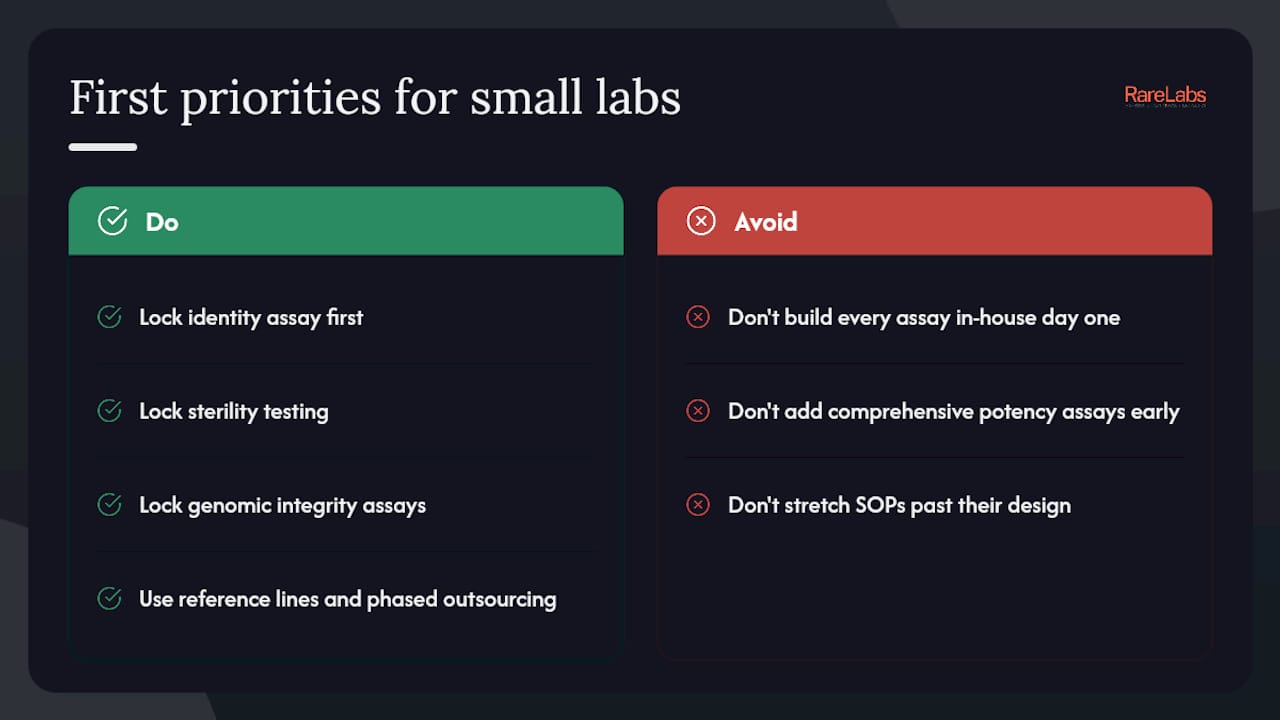
If you're running a small team, don't try to build every assay in-house on day one. Get identity, sterility, and genomic integrity locked down first. Those three catch the failures that waste months. Add comprehensive potency assays once your project actually demands them, not before.
Reference lines and phased outsourcing buy you confidence without a full validation budget. When a project moves toward release-level validation or IND enablement, that's the point to bring in a specialized provider rather than stretch your own SOPs past what they were built for.
— John
When Should You Bring In RareLabs for IPSC Quality Control?
Running a full QC pipeline internally, from karyotyping to trilineage validation to IND-ready documentation, eats months and budget most small labs and family-funded programs don't have. A specialized provider can run that entire pipeline as a contracted service, including patient-derived iPSC model development and biobanking, high-throughput screening of FDA-approved drugs, custom ASO design and rescue validation, and comprehensive IND-enabling data packages for regulatory review.

That matters most for teams facing a specific wall: a rare disease with no existing model, a family or foundation that needs answers faster than a typical academic timeline allows, or a biopharma partner that needs release-level validation without building that capacity from scratch. Hopeatrarelabs's service programs cover disease modeling, parallel treatment screening, and gene therapy feasibility work under one contracted engagement rather than a patchwork of vendors. Browse the protocol and research hub for a closer look at how the process runs, then reach out through the site to scope a program for your specific disease and timeline.
This article is general information, not a substitute for advice from a qualified doctor. Consult a qualified healthcare professional about your own circumstances before acting on anything here.
Sources
- Reassessment of marker genes in human induced pluripotent stem cells for enhanced quality control | Nature Communications
- Toward standardized iPSC testing: Insights from a multi-year international Quality Assessment Round - PMC
- Quality Control Guidelines for Clinical-Grade Human Induced Pluripotent Stem Cell Lines
- Validation of hiPSC-specific GMP-compliant QC assays (2024) | Cytotherapy
FAQ
What Are the Downsides of Using iPSCs?
iPSCs carry real risks including genomic instability that accumulates with passage, incomplete reprogramming that leaves epigenetic memory of the donor cell type, and mosaicism where subpopulations within a single line carry different genetic profiles. These are exactly why tiered genomic testing and periodic karyotype re-checks matter rather than a single pass/fail test at banking.
Why Are iPSCs Better Than Embryonic Stem Cells for Rare Disease Research?
iPSCs are derived directly from a patient's own cells, which means disease models carry the patient's exact genetic background rather than a generic reference genome. That patient-specific match is the reason some labs build disease models from patient-derived iPSCs rather than embryonic lines.
What Is the Success Rate of Making iPSCs?
Reprogramming efficiency varies widely by method, cell source, and protocol, and no single industry-wide success rate applies across labs. What's consistent across guidance is that early QC checkpoints, identity, morphology, and marker screening, should happen on multiple candidate clones per donor before selecting one for banking, since not every colony that emerges will pass downstream testing.
How Much Does an iPSC Cell Line Cost?
Costs vary sharply depending on whether you're buying a standard line from a repository or commissioning a custom patient-derived line with full QC and banking, as detailed in this breakdown of iPSC program costs. Hopeatrarelabs does not publish set pricing for its custom disease-modeling programs; current program scoping and quotes are available directly through the Hopeatrarelabs site.