

A realistic custom antisense oligonucleotide (ASO) program can take a few months in the fastest urgent cases to over a year for typical development, with slower programs potentially stretching beyond that timeframe. The biggest swing factors are toxicology requirements, GMP manufacturing lead time, and how far the patient's disease has already progressed. The FDA's Research IND review window itself typically takes about 30 days. Cases like Milasen show the compressed end is achievable when design, testing, and manufacturing run in parallel rather than back-to-back.
TL;DR:
- A custom antisense oligonucleotide program can range from a few months to over a year, depending on toxicology, manufacturing, and disease stage.
- Parallelizing steps like natural history data collection and regulatory briefs can cut the total timeline by months.
- Urgent cases may qualify for shortened safety studies, but manufacturing delays often remain the primary bottleneck.
- Early patient selection and outcome measure planning are critical to avoid late-stage delays and program extension.
- Specialized disease modeling with patient-derived cells can significantly accelerate lead selection and reduce overall development time.
Table of Contents
- Mapping the ASO Timeline From Eligibility to Maintenance Dosing
- What Happens at Each Stage, and How Long It Actually Takes
- How Does FDA Review Affect an Individualized ASO Timeline?
- Why Patient Selection and Run-In Data Shape the Whole Timeline
- Accelerated Safety Testing and Manufacturing Trade-Offs
- Starting Treatment: Dosing, Monitoring, and Maintenance
- Three Timeline Scenarios and the Red Flags That Extend Them
- How Much Faster Can Specialized Disease Modeling Make an ASO Program?
- Where RareLabs Fits Into Your ASO Timeline
- Where This Timeline Guidance Comes From
- Sources
Mapping the ASO Timeline From Eligibility to Maintenance Dosing
The path from a confirmed genetic diagnosis to a maintenance dosing schedule breaks into distinct stages, and the total ASO timeline depends heavily on which of those stages can overlap rather than queue up one after another.
- Eligibility and dossier review: 2 to 8 weeks
- ASO design and in vitro testing: 4 to 12 weeks
- Lead selection and accelerated safety studies: 2 weeks to 3 months
- GMP or GMP-like manufacturing: 4 to 12 weeks
- IND filing and FDA review: about 30 days once submitted
- First dosing through maintenance monitoring: ongoing, typically starting within weeks of IND clearance
Run-in natural history collection, manufacturing planning, and early regulatory briefings can all happen while design work is still underway. That parallelization is usually what separates a 6-month program from an 18-month one. One planning rule matters more than any other: if a patient's disease is already advanced enough that no measurable benefit could be captured within a 24 to 48 month horizon, most programs are not worth starting, according to guidance from academic and network initiatives like 1M1M and DCRT.
What Happens at Each Stage, and How Long It Actually Takes
Every individualized ASO program follows a fairly consistent sequence, and understanding the substeps helps families evaluate a vendor's quoted timeline against realistic benchmarks.
- Eligibility dossier (2 to 8 weeks). This includes genetic confirmation, a phenotype summary, a record of prior treatments tried, and proposed outcome measures the team plans to track. Delays here usually come from waiting on genetic test results or medical records from multiple providers.
- ASO design and in vitro testing (4 to 12 weeks). Sequence design happens alongside assays in patient-derived cells and disease-model readouts that confirm the candidate actually does what it is supposed to do at the molecular level.
- Lead selection and accelerated in vivo safety (2 weeks to 3 months). Urgent cases may qualify for a 2 to 8 week in-life toxicity package; standard programs use a 3-month rodent safety study.
- Manufacturing (4 to 12 weeks). GMP or GMP-like batch production is one of the most underestimated bottlenecks. Platform chemistries with existing reference data can shave weeks off this step, an approach N1C consensus guidelines recommend specifically to reduce redundant testing.
- IND assembly and filing. The nonclinical report, chemistry/manufacturing/controls (CMC) summary, clinical plan, and informed consent documents all need to be ready before submission, after which the FDA's Research IND process typically takes about 30 days to review.
Pro Tip: Start drafting the informed consent language and clinical monitoring plan while the ASO is still in vitro testing. Those documents rarely depend on final lead-candidate data, and finishing them early keeps the IND package from becoming the last thing holding up submission.
How Does FDA Review Affect an Individualized ASO Timeline?
Individualized Research INDs move differently than standard commercial INDs. They're built around a single patient, they lean on accelerated nonclinical packages when disease severity justifies it, and the FDA has published specific expectations for this category through its guidance on IND submissions for individualized antisense oligonucleotide products. Once submitted, review generally runs the standard 30-day window.
What actually determines whether a program hits that window smoothly:
- Whether a pre-IND briefing happened early enough to flag concerns before the full package was assembled
- Whether the toxicology data package matches what the agency expects for the disease's severity and progression rate
- Whether Institutional Review Board (IRB) approval was pursued in parallel with IND preparation instead of after
- Whether the CMC summary was drafted alongside manufacturing rather than written retroactively
Programs that treat the pre-IND conversation as a formality tend to lose weeks to back-and-forth clarification requests. Programs that use it to align on the toxicology package upfront rarely see review delays beyond the standard 30 days.
Why Patient Selection and Run-In Data Shape the Whole Timeline
Choosing the right patient and the right outcome measures early is what makes an ASO timeline actually hold up later. A short run-in period of natural history data collection lets the team confirm which 3 to 4 outcome measures are likely to shift within the monitoring window, a step reviewed in detail in the N-of-1 ASO literature.
- Run-in data can often draw on existing clinical records and remote monitoring rather than starting from scratch, which shortens this phase considerably.
- Eligibility hinges on whether the mutation is amenable to ASO targeting, the affected tissue is reachable by an ASO delivery route, and outcomes are measurable within roughly 24 to 48 months.
- Very advanced disease progression is the single biggest reason a program gets recommended against. If decline is too fast, there's no realistic window left to detect benefit.
Pro Tip: Ask whoever is running the natural history assessment to lock in outcome measures before preclinical work finishes, not after. Switching outcome measures midstream after safety and manufacturing decisions are already made is one of the more common causes of late-stage timeline slippage.
Accelerated Safety Testing and Manufacturing Trade-Offs
Toxicology and manufacturing are where urgency and caution pull in opposite directions, and where most quoted timelines either hold up or fall apart.
- In certain urgent, rapidly progressive cases, IND filing has been accepted after a very short period of in-life rodent toxicity data when justified by disease progression (source).
- A conventional multi-month rodent safety package remains the standard benchmark when disease progression allows, and the FDA's individualized ASO guidance outlines expectations for study quality depending on the context.
- Manufacturing time can be shortened when platform chemistries with existing reference data are used, allowing some steps to proceed in parallel with safety studies.
- Delivery route and chemistry choices such as GalNAc conjugation or intrathecal delivery influence manufacturing time and dosing schedules, and these factors should be confirmed early with manufacturers (source).
Starting Treatment: Dosing, Monitoring, and Maintenance
First-in-human dosing for a custom ASO typically starts conservatively, often referencing established dosing conventions from approved ASOs like nusinersen as a starting benchmark, followed by a short escalation plan rather than jumping straight to a full dose.
- Monitoring typically involves CSF and blood biomarker tests, clinical outcome assessments, and neurology visits that are frequent initially and become less frequent as safety data accumulates.
- Maintenance dosing for CNS-targeted ASOs delivered intrathecally is commonly scheduled at intervals of a few months, depending on the chemistry and target.
- Start and stop criteria need to be established in advance of treatment initiation to provide a shared framework for families and clinicians to assess treatment response.
Three Timeline Scenarios and the Red Flags That Extend Them
Most programs land in one of three buckets, and knowing which one applies early saves a lot of frustration later.
| Scenario | Typical duration | What drives it |
|---|---|---|
| Fast track | 3 to 6 months | Urgent case, heavy parallelization, minimal added safety testing needed |
| Typical accelerated | 6 to 18 months | Standard preclinical and manufacturing sequence aiming for benefit within 24 to 48 months |
| Slower | 18+ months | Complex molecular target, extended safety or CMC requirements, manufacturing delays |
Three things reliably push a program past its expected window: a manufacturing partner without prior reference chemistry data, a toxicology package that has to be redone after a late change in ASO sequence, and outcome measures chosen too late in the run-in period to be properly validated.
How Much Faster Can Specialized Disease Modeling Make an ASO Program?
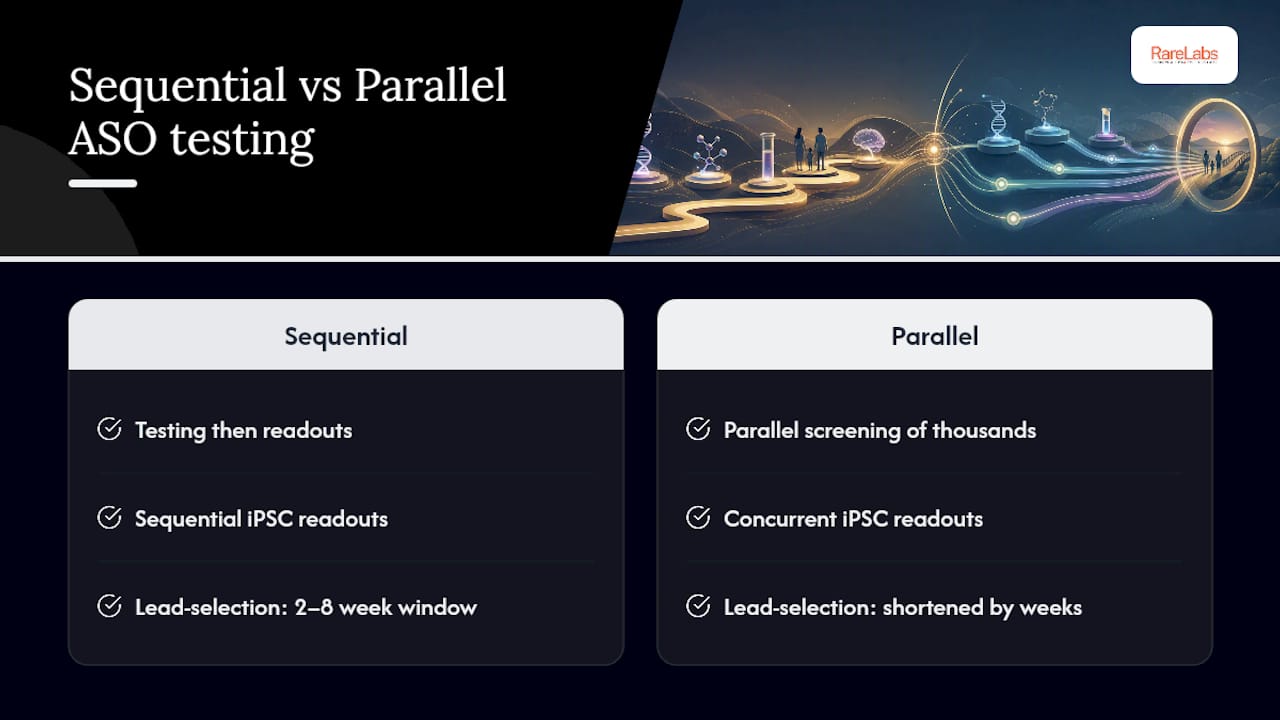
The biggest lever families and clinicians underuse is patient-derived disease modeling run in parallel with drug screening, rather than sequentially. Testing thousands of candidate compounds and custom ASOs against patient-derived induced pluripotent stem cell (iPSC) models in parallel can cut weeks off the lead-selection phase by avoiding sequential readouts.
Families preparing for a scoping conversation save real time by having genetic confirmation, prior treatment history, and a phenotype summary ready before the first call. That's the same eligibility dossier work that otherwise eats into the 2 to 8 week window described earlier. Transparency about what a specific case will realistically require, rather than a generic estimate, is what separates a workable plan from a hopeful one. The technical depth behind that modeling process is covered further in ASO development essentials.
Where RareLabs Fits Into Your ASO Timeline
The company builds patient-specific disease models from patient cells and runs parallel screens across many FDA-approved drugs, custom ASOs, and gene therapy candidates to identify viable options more rapidly than sequential testing. For families, foundations, physicians, and biopharma partners facing a rare or undiagnosed diagnosis, that parallel approach is the practical alternative to a sequential, one-lead-at-a-time development path that can quietly add months to a case that doesn't have months to spare.
A first scoping conversation typically focuses on reviewing the genetic diagnosis, current clinical status, and what's already been tried, so the RareLabs team can give a realistic read on feasibility before any contract is signed. If your family, foundation, or clinical team is trying to figure out whether an individualized ASO program is even the right next step, start a conversation with RareLabs to get a grounded read on timeline and feasibility for your specific case. For background on how custom ASOs compare to other modalities before that call, the ASO comparison guide is a useful starting point.
Where This Timeline Guidance Comes From
- FDA: Investigational New Drug (IND) Application
- FDA guidance: IND submissions for individualized antisense oligonucleotide drug products
- Preparing for patient-customized N-of-1 antisense oligonucleotide therapy to treat rare diseases
- Consensus guidelines for the design and in vitro preclinical efficacy testing N-of-1
- Development of tailored splice-switching oligonucleotides for progressive brain disorders
These sources cover the regulatory framework, the preclinical process, and the consensus recommendations that most individualized ASO programs are built around. Reading them alongside a specific case's genetic and clinical details is the best way to sanity-check any timeline a vendor or research team proposes.
This article is general information, not a substitute for advice from a qualified doctor. Consult a qualified healthcare professional about your own circumstances before acting on anything here.
Sources
- FDA: Investigational New Drug (IND) Application
- Preparing for patient-customized N-of-1 antisense oligonucleotide therapy to treat rare diseases
- Consensus guidelines for the design and in vitro preclinical efficacy testing N-of-1
- Development of tailored splice-switching oligonucleotides for progressive brain disorders: development, regulation, and implementation considerations