

For CNS targets, intrathecally delivered splice-switching ASOs are the most clinically validated approach. For hepatocyte targets, GalNAc-conjugated gapmers offer the strongest biodistribution profile. For retinal disease, intravitreal delivery achieves durable local exposure. That's the short answer. The longer one involves mechanism, chemistry, safety, and whether your variant class even supports an ASO strategy in the first place.
This antisense oligonucleotide therapies comparison covers every major modality in clinical use, the seven FDA-approved or patient-specific ASOs you need to know, and the development decisions that separate programs that reach patients from those that stall in preclinical.
Core trade-offs at a glance:
- Potency vs. delivery feasibility: Gapmers achieve deep target knockdown but require tissue-specific delivery; splice-switching ASOs can restore function without knockdown but only work for amenable splice variants.
- Off-target risk: Phosphorothioate (PS) backbone modifications improve stability but increase protein binding and off-target cleavage risk at high doses; locked nucleic acid (LNA) wings amplify potency but require careful toxicity screening.
- Dosing frequency: Intrathecal CNS dosing is infrequent, intravitreal dosing can have extended intervals, and systemic GalNAc-conjugated ASOs often allow monthly or less frequent subcutaneous dosing.
- Chemistry complexity: Phosphorodiamidate morpholino oligomers (PMOs) avoid most PS-related toxicities but have lower cellular uptake and require higher doses.
FDA-approved and patient-specific ASOs referenced throughout this guide:
- Nusinersen (Spinraza): Splice-switching, intrathecal, spinal muscular atrophy (SMA)
- Eteplirsen (Exondys 51): Exon-skipping PMO, intravenous, Duchenne muscular dystrophy (DMD) exon 51
- Inotersen (Tegsedi): RNase H gapmer, subcutaneous, hereditary transthyretin amyloidosis
- Golodirsen (Vyondys 53): Exon-skipping PMO, intravenous, DMD exon 53
- Casimersen (Amondys 45): Exon-skipping PMO, intravenous, DMD exon 45
- Viltolarsen (VILTEPSO): Exon-skipping PMO, intravenous, DMD exon 53
- Milasen: Patient-specific splice-correcting ASO, intrathecal, Batten disease (N-of-1 case study)
Pro Tip: Before selecting a modality, confirm whether your variant creates a loss-of-function (LoF) or gain-of-function (GoF) pathomechanism. That single determination eliminates roughly half the ASO strategy options before you run a single assay.
Table of Contents
- How ASO mechanisms of action determine chemistry and clinical outcomes
- What backbone and sugar modifications actually do to your ASO program
- Delivery routes and biodistribution: matching chemistry to tissue
- FDA-approved ASO therapies in the United States: key clinical facts
- Head-to-head modality comparison: when to use gapmers, splice-switching, or steric inhibition
- Safety signals you need to monitor and how to mitigate them
- Development and regulatory considerations for U.S. ASO programs
- How to choose the right ASO approach for your program
- How Hopeatrarelabs approaches N-of-1 ASO development
- What the next 3–5 years will change about ASO development
- Key Takeaways
- The case for taking ASO development seriously in rare disease
- Hopeatrarelabs supports your ASO program from model to IND
- Useful sources
How ASO mechanisms of action determine chemistry and clinical outcomes
Understanding how each mechanism works at the molecular level isn't just academic. MOA determines which chemistry you need, which delivery route is feasible, which biomarkers you can use as endpoints, and what toxicities to monitor. Getting this wrong at the design stage is one of the most common causes of late-stage failure.
1. RNase H-mediated knockdown (gapmers)
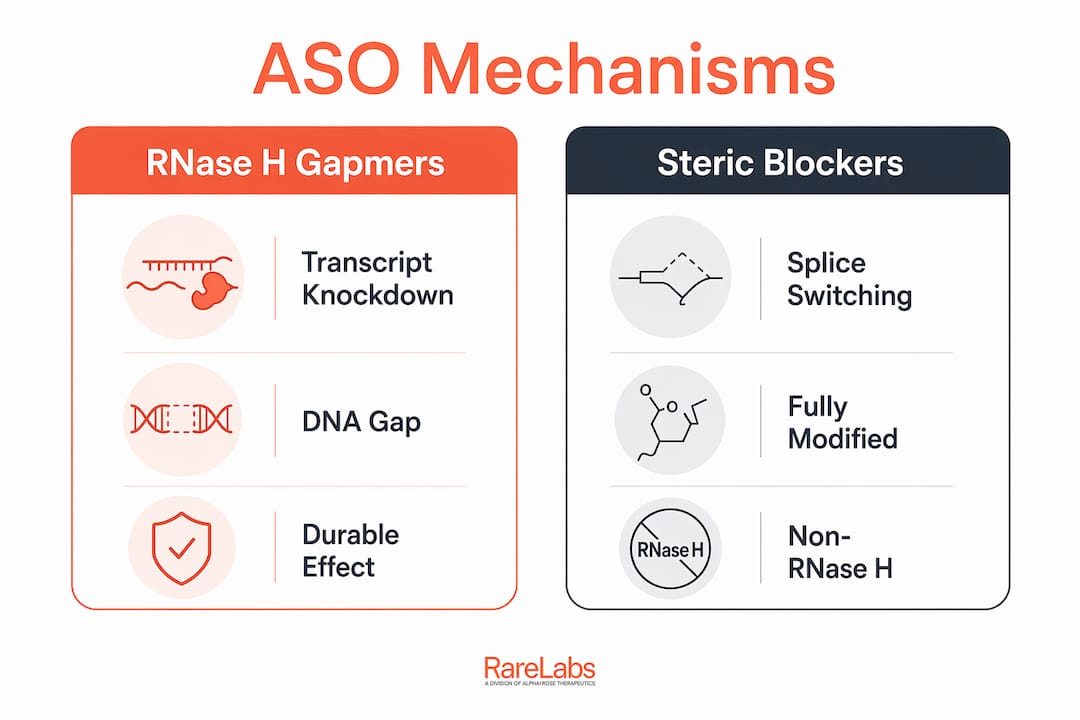
Gapmer ASOs recruit endogenous RNase H1 to cleave the target mRNA at the DNA:RNA heteroduplex. The architecture is a central DNA "gap" flanked by high-affinity modified wings (typically 2'-MOE or LNA). RNase H cleaves the RNA strand, the ASO dissociates, and the cycle repeats. This catalytic mechanism means a single ASO molecule can degrade multiple target transcripts, which is why gapmers achieve deep knockdown at relatively low doses.

Choose gapmers when the therapeutic goal is transcript reduction: GoF mutations, dominant-negative alleles, toxic RNA gain-of-function, or overexpressed disease-driving proteins. Inotersen works exactly this way, reducing hepatic TTR mRNA and the misfolded protein that deposits in peripheral nerves and the heart.
The pharmacodynamic consequence of RNase H cleavage is durable knockdown that outlasts the ASO's tissue half-life, because the target mRNA must be resynthesized. That durability is an asset for dosing frequency but means you need a biomarker that tracks protein levels or downstream pathway activity, not just ASO concentration.
2. Steric-blocking and splice-switching
Steric-blocking ASOs bind pre-mRNA or mature mRNA without recruiting RNase H. The MOA depends on where they bind. Binding near the 5' cap or AUG start codon blocks ribosome assembly and suppresses translation. Binding to intronic splicing silencers, exonic splicing enhancers, or cryptic splice sites redirects the spliceosome, either including a skipped exon or excluding a pseudoexon.
Nusinersen exemplifies splice correction: it blocks an intronic splicing silencer in SMN2 pre-mRNA, promoting inclusion of exon 7 and increasing full-length SMN protein. The DMD exon-skipping drugs (eteplirsen, golodirsen, casimersen, viltolarsen) work by a related mechanism, skipping specific exons to restore the reading frame and produce a truncated but partially functional dystrophin.
Splice-switching ASOs are uniquely suited to LoF conditions caused by splicing mutations or reading-frame disruptions, because they restore function without degrading the target transcript. The clinical endpoint shifts from "how much did we reduce the mRNA" to "how much functional protein did we restore" — a fundamentally different biomarker strategy.
Steric-blocking ASOs are fully modified (no DNA gap), so they do not support RNase H activity. This means 2'-MOE, PMO, or LNA chemistries throughout the sequence, which eliminates most RNase H-related off-target cleavage risk but does not eliminate hybridization-based off-target effects.
3. Translation inhibition and miRNA targeting
Translation-blocking ASOs targeting the 5' UTR or coding sequence are less common in current clinical programs but remain relevant for specific applications where transcript degradation is undesirable. miRNA-targeting ASOs (antimiRs) bind and sequester mature miRNAs, de-repressing their target gene networks. Miravirsen (targeting miR-122) demonstrated proof-of-concept in hepatitis C, though the field has largely moved toward direct-acting antivirals for that indication.
For rare disease programs, miRNA targeting is most relevant when the pathomechanism involves dysregulated miRNA activity rather than a single gene variant, which limits its applicability to N-of-1 contexts.
How MOA maps to clinical endpoints
The role of ASOs in rare disease treatment programs depends heavily on selecting the right biomarker strategy for each MOA. Gapmers need protein-level or functional pathway biomarkers. Splice-switching ASOs need splice-isoform quantification (RT-qPCR, RNA-seq) and protein restoration assays. Translation blockers need protein output measurements directly.
Globally, 19 oligonucleotide therapies have been approved, 10 of which are ASOs, and the approved programs span all three major MOA classes, reflecting how different the clinical development paths are depending on which mechanism you choose.
What backbone and sugar modifications actually do to your ASO program
Chemistry selection is where many programs make their first consequential mistake. The instinct is to reach for the most potent modification available, but potency and safety don't always move in the same direction.
Phosphorothioate backbone
Replacing a non-bridging oxygen with sulfur in the backbone creates a PS linkage. PS modification is the foundation of nearly every clinical ASO: it dramatically improves nuclease resistance, extends plasma half-life, and promotes cellular uptake through protein binding. The downside is that PS linkages increase non-specific protein binding, which drives complement activation, thrombocytopenia at high doses, and injection-site reactions. Many approved ASOs in the U.S. use PS backbone, at least partially.
2'-O-methyl and 2'-MOE
2'-O-methyl (2'-OMe) substitution adds a methyl group to the 2' oxygen of the ribose. It improves binding affinity and nuclease resistance and is well-tolerated. 2'-O-methoxyethyl (2'-MOE) goes further, adding a methoxyethyl group that provides higher affinity and better resistance to nucleases than 2'-OMe. Nusinersen uses a full 2'-MOE PS backbone. The N=1 Collaborative guidelines specifically recommend MOE PS chemistry with 5-methylated cytosine and uridine for N-of-1 programs because the existing human safety data shortens the required preclinical package.
PMO chemistry
Phosphorodiamidate morpholino oligomers replace the ribose sugar with a morpholine ring and the phosphodiester backbone with a phosphorodiamidate linkage. PMOs are uncharged, which eliminates most PS-related protein binding and the associated toxicities. All four approved DMD exon-skipping drugs use PMO chemistry. The trade-off: PMOs have lower cellular uptake than PS-modified ASOs, require higher doses, and are more expensive to manufacture at scale.
LNA
Locked nucleic acid introduces a methylene bridge between the 2' oxygen and 4' carbon of the ribose, "locking" it in a C3'-endo conformation. LNA dramatically increases binding affinity (Tm increases of 2–8°C per LNA monomer) and nuclease resistance. Used in gapmer wings, LNA allows shorter sequences with equivalent or superior potency. The risk: LNA-containing gapmers have shown hepatotoxicity in some programs, attributed to both sequence-dependent and chemistry-dependent mechanisms. LNA gapmers require careful hepatotoxicity screening before advancing.
Gapmer architecture and off-target cleavage
The gapmer design places modified wings (2'-MOE, LNA, or 2'-OMe) flanking a central DNA gap of 8–12 nucleotides. RNase H only cleaves within the DNA gap region, which limits off-target cleavage to transcripts that hybridize across the gap. Longer gaps increase RNase H activity but also increase the probability of partial complementarity to off-target transcripts. Shorter gaps reduce off-target risk but may reduce potency. Optimizing gap length is a standard step in lead candidate selection.
Chemistry comparison: key trade-offs
| Chemistry | Potency | Nuclease resistance | Immunostimulation risk | Manufacturing complexity | Key clinical use |
|---|---|---|---|---|---|
| PS backbone (DNA) | Moderate | High | Moderate–high | Low | Gapmers (with wings) |
| 2'-MOE PS | High | Very high | Low–moderate | Moderate | Splice-switching, gapmers |
| PMO | Moderate | Very high | Very low | High | Exon skipping (DMD) |
| LNA (gapmer wings) | Very high | Very high | Low–moderate | High | Gapmers, short sequences |
| 2'-OMe PS | Moderate–high | High | Low | Low | Splice-switching, antimiRs |
Practical guidance for chemistry selection:
- For N-of-1 programs targeting the CNS via intrathecal delivery, MOE PS is the preferred starting chemistry because of its established human safety data and the ability to leverage existing preclinical packages.
- For liver targets, GalNAc-conjugated 2'-MOE or LNA gapmers are the standard; LNA wings allow dose reduction but require hepatotoxicity screening.
- For muscle targets using PMO, expect higher dose requirements and plan for the manufacturing cost implications early.
- Delivery and chemical modification advances are the primary levers for expanding treatable tissues and improving the therapeutic index across all ASO classes.
Delivery routes and biodistribution: matching chemistry to tissue
Delivery is where the gap between a promising sequence and a viable drug is widest. An ASO with perfect target affinity and a clean safety profile is useless if it can't reach the relevant tissue at therapeutic concentrations.
Systemic delivery: GalNAc conjugation and LNPs
GalNAc (N-acetylgalactosamine) conjugation exploits the asialoglycoprotein receptor (ASGPR), which is highly expressed on hepatocytes and mediates rapid, receptor-mediated endocytosis. Subcutaneous injection of GalNAc-conjugated ASOs achieves robust liver uptake with minimal systemic exposure, allowing dose reduction by roughly 10-fold compared to unconjugated PS ASOs. Inotersen uses subcutaneous delivery without GalNAc conjugation; next-generation TTR-targeting ASOs use GalNAc to improve the therapeutic index.

Lipid nanoparticles (LNPs) are the dominant delivery vehicle for hepatic siRNA (as in patisiran), but their application to ASOs is less established. LNPs require intravenous administration and carry their own immunogenicity considerations. For ASO programs targeting the liver, GalNAc conjugation is generally preferred over LNPs because of the simpler administration route and more favorable safety profile.
Intrathecal delivery for CNS
The blood-brain barrier (BBB) blocks systemic delivery of most ASOs to the CNS at therapeutic concentrations. Intrathecal injection bypasses the BBB entirely, distributing the ASO through cerebrospinal fluid to reach neurons and glial cells throughout the spinal cord and brain. Nusinersen is administered intrathecally, with a loading phase followed by maintenance dosing approximately every 4 months. CNS dosing cadence for intrathecal ASOs is typically every 3–4 months, reflecting the slow CSF turnover and long tissue half-life of 2'-MOE PS ASOs in neural tissue.
Intravitreal delivery for retinal disease
The retina is pharmacologically isolated from systemic circulation, making intravitreal injection the standard route for ocular ASO programs. Intravitreal dosing achieves high local concentrations with minimal systemic exposure. Dosing intervals of approximately 6 months are achievable for well-optimized ASOs in the retina, given the low metabolic activity and slow turnover of retinal cells.
Barriers to muscle and other tissues
Muscle delivery remains one of the most significant unmet challenges in the ASO field. Systemic delivery of unconjugated ASOs achieves poor muscle uptake; PMO-based DMD drugs require intravenous infusion at high doses to achieve meaningful dystrophin restoration. Peptide-conjugated PMOs (PPMOs) show improved muscle uptake in preclinical models, but clinical translation has been complicated by safety signals. Lung, pancreas, and cardiac muscle remain similarly difficult to target efficiently.
Pro Tip: For any new target tissue, map the biodistribution of your chosen chemistry in a relevant animal model before committing to a clinical delivery route. Assumptions based on published data from a different tissue or chemistry class frequently don't hold.
Delivery route summary by tissue:
| Target tissue | Preferred delivery route | Chemistry class | Dosing cadence (clinical) | Key limitation |
|---|---|---|---|---|
| Liver | Subcutaneous (GalNAc) | 2'-MOE PS, LNA PS | Monthly or less frequent | Hepatotoxicity at high doses |
| CNS (spinal cord/brain) | Intrathecal | 2'-MOE PS | Every 3–4 months | Procedural burden |
| Retina | Intravitreal | 2'-MOE PS | ~Every 6 months | Ocular inflammation |
| Muscle | Intravenous (high dose) | PMO | Weekly–monthly | Poor uptake, high dose needed |
| Systemic/other | IV or SC (unconjugated) | PS-based | Variable | Off-target distribution |
FDA-approved ASO therapies in the United States: key clinical facts
Fourteen years of FDA approvals have produced a reference set of ASO programs that define what clinical success looks like across mechanisms, chemistries, and indications. The table below covers the seven programs named in mandatory coverage, plus Milasen as the canonical N-of-1 case.
| Drug (brand) | MOA | Chemistry | Route | Indication | Pivotal endpoint | Key safety signals | Dosing cadence |
|---|---|---|---|---|---|---|---|
| Nusinersen (Spinraza) | Splice-switching (SMN2 exon 7 inclusion) | 2'-MOE PS | Intrathecal | SMA (all types) | Motor milestone achievement (ENDEAR trial) | Thrombocytopenia, coagulation abnormalities, renal toxicity | Loading × 4, then every 4 months |
| Eteplirsen (Exondys 51) | Exon 51 skipping (dystrophin frame restoration) | PMO | IV infusion | DMD (exon 51 amenable) | Dystrophin increase (Western blot/IHC) | Injection-site reactions; limited systemic toxicity | Weekly IV |
| Inotersen (Tegsedi) | RNase H knockdown (TTR mRNA) | 2'-MOE PS | Subcutaneous | Hereditary TTR amyloidosis (polyneuropathy) | mNIS+7 neuropathy score (NEURO-TTR) | Thrombocytopenia, glomerulonephritis, renal toxicity | Weekly SC |
| Golodirsen (Vyondys 53) | Exon 53 skipping (dystrophin frame restoration) | PMO | IV infusion | DMD (exon 53 amenable) | Dystrophin increase | Renal toxicity, injection-site reactions | Weekly IV |
| Casimersen (Amondys 45) | Exon 45 skipping (dystrophin frame restoration) | PMO | IV infusion | DMD (exon 45 amenable) | Dystrophin increase | Renal toxicity, injection-site reactions | Weekly IV |
| Viltolarsen (VILTEPSO) | Exon 53 skipping (dystrophin frame restoration) | PMO | IV infusion | DMD (exon 53 amenable) | Dystrophin increase | Renal toxicity, injection-site reactions | Weekly IV |
| Milasen | Splice-correcting (cryptic exon blocking) | 2'-MOE PS | Intrathecal | Batten disease (patient-specific, N-of-1) | Seizure frequency reduction (single patient) | Not generalizable; case-specific | Individualized |
Notes on the approved landscape:
- The four DMD exon-skipping drugs (eteplirsen, golodirsen, casimersen, viltolarsen) all received accelerated approval based on dystrophin as a surrogate endpoint. Confirmatory trials demonstrating clinical benefit are ongoing.
- Inotersen carries a boxed warning for thrombocytopenia and glomerulonephritis; platelet monitoring is mandatory throughout treatment.
- Nusinersen's ENDEAR trial used motor milestone achievement in infantile-onset SMA as the primary endpoint, a functional outcome that set the standard for CNS ASO programs.
- Milasen was developed for a single child with a private mutation creating a cryptic splice site in the CLN7 gene. The case established that N-of-1 ASO development is feasible within an academic-clinical collaboration but requires rapid, rigorous preclinical validation before any clinical use.
- ASOs account for 58.8% of marketed oligonucleotide drugs globally, reflecting the breadth of mechanisms and indications the class can address.
Head-to-head modality comparison: when to use gapmers, splice-switching, or steric inhibition
No single ASO modality is universally superior. The right choice depends on the pathomechanism, the target tissue, the variant class, and the development timeline you can realistically support.
Modality comparison matrix:
| Dimension | RNase H gapmer | Splice-switching ASO | Steric-blocking (translation) |
|---|---|---|---|
| Primary MOA | mRNA degradation via RNase H | Splice redirection (exon inclusion/skipping) | Ribosome or splicing factor blockade |
| Best chemistry | 2'-MOE PS, LNA PS | 2'-MOE PS, PMO | 2'-MOE PS, 2'-OMe PS |
| Preferred delivery | SC (GalNAc/liver), intrathecal | Intrathecal, IV (PMO) | Intrathecal, intravitreal |
| Tissue suitability | Liver (strong), CNS (moderate), retina | CNS (strong), muscle (PMO), retina | CNS, retina |
| Potency/durability | High potency, durable knockdown | Moderate; depends on splice efficiency | Variable; depends on target site |
| Off-target risk | RNase H cleavage + hybridization | Hybridization only | Hybridization only |
| Best disease class | GoF, dominant-negative, toxic RNA | LoF with splice-amenable variant | Overexpression, specific splice suppression |
| Development complexity | Moderate | Moderate–high (variant screening required) | Moderate |
Clinical decision rules:
- Use a splice-switching ASO when the variant creates an aberrant splice site, disrupts a splice regulatory element, or causes a reading-frame shift correctable by exon skipping. Confirm the variant is a single nucleotide variant, small indel, or single-exon deletion before committing. Larger structural variants are generally not amenable to this approach.
- Use a gapmer when the goal is transcript knockdown: GoF mutations, dominant-negative alleles, or toxic RNA accumulation. Liver targets with GalNAc delivery are the most straightforward development path.
- Consider steric-blocking for translation suppression of overexpressed targets or for blocking specific regulatory RNA elements without degrading the transcript.
When comparing ASOs to other modalities, gene therapy approaches offer permanent correction but carry higher manufacturing complexity and immunogenicity risk. siRNA achieves similar knockdown to gapmers with potentially better tolerability in hepatocytes but requires LNP or GalNAc delivery and has a shorter tissue half-life. CRISPR-based editing offers permanent genomic correction but faces its own delivery and off-target challenges. For programs where the variant is known, the target tissue is accessible, and a reversible approach is preferred, ASOs remain the fastest path to a clinical candidate.
Misaligning mechanism to pathomechanism is the most common cause of early failure. LoF conditions need restoration or splice correction; GoF conditions need knockdown or allele-selective approaches. Applying the wrong MOA to a variant class is a design error that no amount of chemistry optimization will fix.
Safety signals you need to monitor and how to mitigate them
ASO safety profiles are chemistry-dependent, dose-dependent, and partly sequence-dependent. The approved programs have generated enough clinical data to define the major risk categories and what monitoring looks like in practice.
Major safety signals across ASO programs
Thrombocytopenia is the most serious class effect for PS-modified ASOs. Inotersen carries a boxed warning; volanesorsen (approved in Europe for familial chylomicronemia syndrome) was associated with severe thrombocytopenia in clinical trials. A network meta-analysis of APOC3-targeting oligonucleotides across 10 randomized controlled trials found that thrombocytopenia and injection-site reactions were the most notable safety issues for this drug class. The mechanism involves PS backbone binding to platelet factor 4 and complement activation. PMO-based drugs (the DMD exon-skipping series) have a much lower thrombocytopenia risk because they lack the PS backbone.
Renal toxicity is observed with subcutaneously administered PS ASOs that accumulate in proximal tubular cells. Inotersen, nusinersen, and the DMD drugs all carry renal monitoring requirements in their FDA labels. Proteinuria and elevated serum creatinine are the primary signals.
Immunostimulation and complement activation occur with PS-modified ASOs, particularly at higher doses. Injection-site reactions (erythema, induration) are the most common manifestation. Systemic complement activation is less frequent but has been observed with some programs.
Hepatotoxicity is a specific concern for LNA-containing gapmers. Elevated liver enzymes (ALT/AST) have caused clinical holds in several LNA gapmer programs. The mechanism is partly sequence-dependent (some sequences are intrinsically hepatotoxic regardless of chemistry) and partly chemistry-dependent.
Recommended monitoring checklist for U.S. clinical programs
- Platelet count: Baseline, then every 2 weeks for the first 3 months, then monthly. Stopping rule: platelets below 75,000/μL warrants dose interruption; below 50,000/μL warrants discontinuation.
- Renal function panel: Serum creatinine, BUN, urinalysis with microscopy at baseline and every 3 months.
- Liver function tests: ALT, AST, bilirubin at baseline and monthly for LNA-containing gapmers; every 3 months for 2'-MOE PS programs.
- Complement levels (C3, C4, CH50): For programs with systemic PS exposure; baseline and at each dosing visit during loading phase.
- Injection-site assessment: At each visit; document grade per CTCAE criteria.
- Coagulation studies (PT, aPTT): Baseline and periodically for intrathecal programs (nusinersen label precedent).
Design and CMC considerations that reduce risk
- Choosing 2'-MOE PS over LNA for N-of-1 programs reduces hepatotoxicity risk while maintaining an established safety database.
- Controlling PS diastereomer ratios and minimizing n-1 and n+1 impurities during synthesis reduces non-specific protein binding and immunostimulation.
- Sequence screening for known hepatotoxic motifs (e.g., certain CpG-containing sequences) before lead selection avoids the most predictable chemistry-independent toxicities.
- FDA label warnings for inotersen and nusinersen are publicly available on the FDA drug label database and provide the most current monitoring requirements for U.S. programs.
Development and regulatory considerations for U.S. ASO programs
The IND pathway for an individualized ASO is not identical to a standard small-molecule IND, and the differences matter for timeline and cost planning.
-
CMC requirements: ASOs are synthetic oligonucleotides with well-defined structures, but the FDA expects full characterization of the drug substance and drug product, including sequence confirmation, purity (HPLC), residual solvents, endotoxin, and sterility. For N-of-1 programs, the FDA has issued specific guidance on IND submissions for individualized ASO products that addresses administrative and procedural requirements distinct from standard INDs.
-
Potency assays: The FDA expects a potency assay tied to the MOA. For splice-switching ASOs, RT-qPCR quantifying the target splice isoform ratio in a relevant cell model is standard. For gapmers, target mRNA or protein reduction in a cell-based assay serves this purpose. The assay must be validated (or at minimum qualified) before IND submission.
-
Biomarker strategy: Surrogate biomarkers must be biologically plausible and, ideally, supported by natural history data. For N-of-1 programs in ultra-rare diseases, the FDA has shown flexibility on endpoint selection when functional outcomes are impractical to measure in a single patient. Seizure frequency (as in Milasen) and functional scales adapted from related conditions are precedents.
-
Preclinical safety package: Using MOE PS chemistry with an established human safety track record can reduce the required preclinical package in some contexts, but U.S. INDs for N-of-1 programs still require rodent safety data. The N=1 Collaborative consensus recommends standardized experimental designs and validated cellular models to maximize the value of limited preclinical resources.
-
Pre-IND meeting: Request a Type B pre-IND meeting with FDA's CDER to align on the preclinical package, potency assay, and clinical monitoring plan before committing to GMP manufacturing. This meeting is particularly valuable for N-of-1 programs where regulatory precedent is limited.
-
Named-patient vs. IND pathway: In Europe, named-patient or compassionate-use pathways can sometimes allow clinical use before a full IND-equivalent submission. In the U.S., an IND is required for any clinical investigation, including N-of-1 programs. There is no equivalent U.S. named-patient pathway that bypasses IND requirements.
Pro Tip: For N-of-1 programs, engage the FDA early and frame the pre-IND meeting around the specific chemistry and delivery route you plan to use. Regulators have more flexibility on endpoint design than on preclinical safety data requirements, so don't trade one for the other.
How to choose the right ASO approach for your program
Work through these questions in order. Each one narrows the feasible strategy space before you invest in assay development.
-
What is the pathomechanism? LoF (splice correction or exon skipping) vs. GoF/dominant-negative (knockdown) vs. toxic RNA accumulation (knockdown or steric blocking). This is the first filter.
-
What is the variant class? Single nucleotide variants, small indels, and single-exon deletions are amenable to splice-switching approaches. Larger structural variants, repeat expansions, and multi-exon deletions generally are not. For knockdown programs, variant class is less restrictive.
-
What is the target tissue? Liver: GalNAc-conjugated gapmer or siRNA. CNS: intrathecal splice-switching or gapmer. Retina: intravitreal. Muscle: PMO-based exon skipping (with acknowledged delivery limitations). Other tissues: assess delivery feasibility before committing to a chemistry.
-
Is a validated disease model available? Patient-derived iPSCs or primary cells expressing the target variant are the gold standard for in vitro validation. Without a validated model, you cannot confirm functional rescue before clinical use. Standardized in vitro testing using validated cellular models and reference ASOs is the minimum bar for N-of-1 programs.
-
What biomarker can you measure? Identify a measurable, biologically plausible biomarker before designing the ASO screen. If no biomarker exists, the program cannot be clinically validated.
-
What is the safety tolerability constraint? For pediatric patients or those with pre-existing renal or hepatic compromise, PMO chemistry or 2'-MOE PS with careful dose selection is preferred over LNA-containing gapmers.
-
What is the realistic timeline? N-of-1 programs using established chemistries and validated models can move from sequence design to IND in 12–18 months under optimal conditions. Novel delivery approaches or unvalidated target tissues add 12–24 months.
Prioritized next steps after modality selection:
- Confirm splice amenability or knockdown feasibility in a relevant cell model (patient fibroblasts, iPSC-derived cells, or an appropriate surrogate).
- Screen a panel of 5–10 candidate ASO sequences for potency and selectivity using RT-qPCR and Western blot.
- Run a preliminary toxicity screen (cell viability, off-target transcriptome analysis by RNA-seq) on the top 2–3 candidates.
- Advance the lead candidate to in vivo pharmacology in a relevant animal model before committing to GMP synthesis.
- Initiate pre-IND planning in parallel with in vivo studies to avoid timeline gaps.
For programs targeting rare genetic diseases, the decision framework above applies whether you are developing a population-scale drug or a single-patient ASO. The difference is in the scale of the preclinical package and the regulatory pathway, not the scientific logic.
How Hopeatrarelabs approaches N-of-1 ASO development
Hopeatrarelabs runs a structured workflow designed to compress the time between variant identification and a go/no-go preclinical decision. The process starts with patient-derived cells, typically reprogrammed into iPSCs, which are then differentiated into the disease-relevant cell type. CRISPR-edited isogenic controls are generated in parallel to confirm that phenotypic differences are variant-specific rather than background-dependent.
The most common failure point in N-of-1 ASO programs isn't sequence design. It's the absence of a validated disease model that can distinguish ASO-mediated functional rescue from noise. Every program at Hopeatrarelabs begins with model validation before a single ASO sequence is screened.
ASO candidates are screened using RT-qPCR for splice isoform quantification, RNA-seq for transcriptome-wide off-target assessment, and functional assays specific to the disease cell type (electrophysiology for neurons, contractility for cardiomyocytes, metabolic assays for hepatocytes). Toxicity markers including cell viability, mitochondrial function, and inflammatory cytokine release are assessed in parallel with efficacy.
The standardized approach draws on N=1 Collaborative consensus guidelines, including the use of reference ASOs as internal controls and validated experimental designs that support regulatory submissions. Collaboration with the treating clinician and the patient's family is built into the workflow from the start, because the clinical endpoint and the acceptable safety profile are patient-specific decisions, not just scientific ones.
Pro Tip: Reference ASOs with known activity in your target cell model are not optional controls. They are the only way to confirm your assay is working before you interpret candidate ASO results. Hopeatrarelabs includes validated reference ASOs in every screen.
Any clinical use of an ASO developed through this workflow requires an IND submission to the FDA, and Hopeatrarelabs supports the translational documentation needed for that submission. The preclinical package, potency assay data, and CMC documentation generated during the screening program are structured to align with FDA IND requirements for individualized ASO products.
What the next 3–5 years will change about ASO development
The approved programs define what's possible today. The research priorities below define where the field needs to go to expand the number of patients who can benefit.
Delivery to underserved tissues:
- Muscle delivery is the most urgent unmet need. Peptide-conjugated PMOs (PPMOs) and cell-penetrating peptide conjugates show preclinical promise but have not yet cleared clinical safety hurdles. Exosome-based delivery and receptor-targeted conjugates are in early development.
- Lung delivery via inhaled ASOs is an active area for respiratory diseases; aerosolized delivery avoids systemic exposure but requires formulation optimization for stability and deep lung penetration.
- Cardiac muscle and pancreatic beta cells remain largely inaccessible to current ASO delivery systems.
Reducing off-target effects:
- Improved sequence design algorithms incorporating transcriptome-wide hybridization prediction reduce off-target hybridization before synthesis. Machine learning models trained on existing ASO datasets are beginning to improve selectivity predictions.
- Shorter, higher-affinity sequences using LNA or constrained ethyl (cEt) modifications can achieve equivalent potency at lower doses, reducing the concentration-dependent off-target effects driven by PS backbone protein binding.
- Chemistry and delivery improvements remain the primary levers for expanding the therapeutic index across all ASO classes.
Durability and dosing burden:
- Intrathecal dosing every 3–4 months is a significant burden for pediatric patients with SMA. Research into depot formulations and sustained-release intrathecal systems could extend dosing intervals.
- For liver-targeted programs, GalNAc conjugation already allows monthly or less frequent dosing; further chemistry optimization may push intervals to quarterly.
Manufacturing scale and cost:
- PMO synthesis is more expensive than PS-modified ASO synthesis at equivalent scales. As DMD exon-skipping programs expand to broader patient populations, manufacturing cost will become a commercial viability constraint.
- Solid-phase synthesis scale-up for GMP production of 2'-MOE PS ASOs is well-established; LNA-containing sequences require additional quality controls that add cost and cycle time.
- ASOs represent 58.8% of marketed oligonucleotide drugs, and the manufacturing infrastructure built for approved programs is increasingly available to support new entrants, including N-of-1 programs.
Combination strategies:
- Combining ASOs with gene therapy is an emerging approach for diseases where ASO-mediated splice correction can bridge the gap until gene therapy manufacturing is complete, or where ASO knockdown of a dominant-negative allele is combined with gene replacement of the functional copy.
Key Takeaways
Splice-switching ASOs delivered intrathecally are the most clinically validated approach for CNS targets, while GalNAc-conjugated gapmers offer the strongest biodistribution for liver targets, and modality-mechanism alignment is the single most important determinant of program success.
| Point | Details |
|---|---|
| Mechanism drives everything | Matching MOA to pathomechanism (LoF vs. GoF) is the first and most critical design decision. |
| Chemistry shapes safety | 2'-MOE PS is preferred for N-of-1 CNS programs; PMO eliminates most PS toxicities but requires higher doses. |
| Delivery limits tissue access | Liver (GalNAc), CNS (intrathecal), and retina (intravitreal) are accessible; muscle and other tissues remain challenging. |
| Safety monitoring is mandatory | Platelet counts, renal function, and liver enzymes require structured monitoring per FDA label precedents for all PS-modified ASOs. |
| Hopeatrarelabs workflow | Hopeatrarelabs uses iPSC-derived disease models, reference ASO controls, and RNA-seq off-target screening to support go/no-go decisions for N-of-1 programs. |
The case for taking ASO development seriously in rare disease
The conventional framing of ASO therapy as a niche tool for a handful of well-funded rare disease programs misses what's actually happening. The Milasen case didn't just prove that a single patient could receive a custom ASO. It proved that the scientific and regulatory infrastructure for individualized molecular medicine already exists, and that the bottleneck is not biology. It's execution.
What most programs underestimate is how much of the hard work happens before the first ASO sequence is synthesized. Target validation, model development, biomarker identification, and regulatory strategy are not preliminary steps. They are the program. A team that rushes to sequence design without a validated disease model will generate potency data that doesn't translate, and a regulatory package that the FDA will not accept.
The other underappreciated reality: chemistry choice is a regulatory decision as much as a scientific one. Choosing 2'-MOE PS for a CNS N-of-1 program isn't just about potency. It's about leveraging an existing human safety database to reduce the preclinical burden and compress the timeline to IND. That's a decision that saves months, not weeks, and in rare disease programs where patients are deteriorating, months matter.
The field is moving toward RNA-targeting approaches precisely because transitioning from protein-centric drugs to ASOs opens targets that were previously undruggable. The programs that will succeed are the ones that treat delivery and chemistry as primary constraints from day one, not afterthoughts to be solved after the sequence is locked.
Hopeatrarelabs supports your ASO program from model to IND
For families, clinicians, and biopharma partners facing a rare disease with no approved treatment, the path from variant identification to a viable ASO candidate requires more than sequence design software. It requires validated disease models, structured preclinical screens, and translational documentation that holds up under regulatory scrutiny.

Hopeatrarelabs builds patient-derived iPSC models, runs high-throughput ASO screens with validated reference controls, and generates the potency, selectivity, and safety data needed to support an IND submission. The workflow is designed for ultra-rare and undiagnosed diseases where no established model exists and no off-the-shelf assay applies. Every program includes RNA-seq off-target profiling, functional rescue confirmation in disease-relevant cell types, and direct collaboration with the treating clinical team.
For programs at the feasibility stage, the RareLabs Knowledge page provides detailed information on the screening workflow, the types of variants and diseases the platform is designed to address, and how to initiate a program. If you are evaluating whether an ASO approach is viable for a specific variant or disease, that's the right starting point.
Useful sources
FDA regulatory documents:
- FDA guidance: IND submissions for individualized antisense oligonucleotide drug products — Administrative and procedural requirements specific to N-of-1 ASO INDs in the U.S.
Consensus guidelines and clinical recommendations:
- Consensus Guidelines for the Design and In Vitro Preclinical Efficacy Testing of N-of-1 Exon Skipping ASOs — N=1 Collaborative workshop recommendations covering chemistry, assay design, and preclinical standards.
- Practical Recommendations for the Selection of Patients for Individualized Splice-Switching ASO Treatments — Variant eligibility criteria and global approval counts for oligonucleotide drugs.
Review articles:
- Frontiers in Pharmacology (2023): ASO pharmacological strategy — High-level review of ASO mechanisms, chemistry, and the shift from protein-targeted to RNA-targeting therapeutics.
- Possibilities and limitations of ASO therapies for monogenic disorders (Communications Medicine) — Delivery constraints by tissue and current limitations for muscle and other underserved targets.
- Review on delivery platforms and chemical modifications for nucleic acid therapeutics — Chemistry and delivery advances as the primary levers for expanding treatable tissues.
Clinical and market data:
- Safety and efficacy of ASOs on triglyceride and APOC3 levels: network meta-analysis — Meta-analysis of 10 RCTs covering efficacy and safety trade-offs including thrombocytopenia signals.
- Global and Chinese trends in oligonucleotide drug clinical development — Pipeline and market data on ASO approvals and R&D growth.
Active trial registry:
- ClinicalTrials.gov — Search for active ASO trials by indication, chemistry, or sponsor; consult individual trial records for current enrollment status and endpoints.
NCATS ASO glossary:
- NCATS Toolkit: Antisense oligonucleotide definition and mechanism overview — Concise reference on ASO mechanism classes for clinical and research audiences.
This article is general scientific and educational information, not medical or regulatory advice. Confirm current FDA requirements, label warnings, and clinical protocols with the relevant primary sources or a qualified regulatory professional for your specific program.